

2026 Provide Updated Databricks Databricks-Generative-AI-Engineer-Associate Dumps as Practice Test and PDF
Databricks-Generative-AI-Engineer-Associate Dumps are Available for Instant Access
NEW QUESTION # 25
A Generative Al Engineer is tasked with developing a RAG application that will help a small internal group of experts at their company answer specific questions, augmented by an internal knowledge base. They want the best possible quality in the answers, and neither latency nor throughput is a huge concern given that the user group is small and they're willing to wait for the best answer. The topics are sensitive in nature and the data is highly confidential and so, due to regulatory requirements, none of the information is allowed to be transmitted to third parties.
Which model meets all the Generative Al Engineer's needs in this situation?
- A. Dolly 1.5B
- B. Llama2-70B
- C. OpenAI GPT-4
- D. BGE-large
Answer: D
Explanation:
* Problem Context: The Generative AI Engineer needs a model for a Retrieval-Augmented Generation (RAG) application that provides high-quality answers, where latency and throughput are not major concerns. The key factors are confidentiality and sensitivity of the data, as well as the requirement for all processing to be confined to internal resources without external data transmission.
* Explanation of Options:
Option A: Dolly 1.5B: This model does not typically support RAG applications as it's more focused on image generation tasks.
Option B: OpenAI GPT-4: While GPT-4 is powerful for generating responses, its standard deployment involves cloud-based processing, which could violate the confidentiality requirements due to external data transmission.
Option C: BGE-large: The BGE (Big Green Engine) large model is a suitable choice if it is configured to operate on-premises or within a secure internal environment that meets regulatory requirements. Assuming this setup, BGE-large can provide high-quality answers while ensuring that data is not transmitted to third parties, thus aligning with the project's sensitivity and confidentiality needs.
Option D: Llama2-70B: Similar to GPT-4, unless specifically set up for on-premises use, it generally relies on cloud-based services, which might risk confidential data exposure.
Given the sensitivity and confidentiality concerns, BGE-large is assumed to be configurable for secure internal use, making it the optimal choice for this scenario.
NEW QUESTION # 26
A Generative Al Engineer is deciding between using LSH (Locality Sensitive Hashing) and HNSW (Hierarchical Navigable Small World) for indexing their vector database Their top priority is semantic accuracy Which approach should the Generative Al Engineer use to evaluate these two techniques?
- A. Compare the Recall-Onented-Understudy for Gistmg Evaluation (ROUGE) scores of returned results for a representative sample of test inputs
- B. Compare the Levenshtein distances of returned results against a representative sample of test inputs
- C. Compare the Bilingual Evaluation Understudy (BLEU) scores of returned results for a representative sample of test inputs
- D. Compare the cosine similarities of the embeddings of returned results against those of a representative sample of test inputs
Answer: D
Explanation:
The task is to choose between LSH and HNSW for a vector database index, prioritizing semantic accuracy.
The evaluation must assess how well each method retrieves semantically relevant results. Let's evaluate the options.
* Option A: Compare the cosine similarities of the embeddings of returned results against those of a representative sample of test inputs
* Cosine similarity measures semantic closeness between vectors, directly assessing retrieval accuracy in a vector database. Comparing returned results' embeddings to test inputs' embeddings evaluates how well LSH or HNSW preserves semantic relationships, aligning with the priority.
* Databricks Reference:"Cosine similarity is a standard metric for evaluating vector search accuracy"("Databricks Vector Search Documentation," 2023).
* Option B: Compare the Bilingual Evaluation Understudy (BLEU) scores of returned results for a representative sample of test inputs
* BLEU evaluates text generation (e.g., translations), not vector retrieval accuracy. It's irrelevant for indexing performance.
* Databricks Reference:"BLEU applies to generative tasks, not retrieval"("Generative AI Cookbook").
* Option C: Compare the Recall-Oriented-Understudy for Gisting Evaluation (ROUGE) scores of returned results for a representative sample of test inputs
* ROUGE is for summarization evaluation, not vector search. It doesn't measure semantic accuracy in retrieval.
* Databricks Reference:"ROUGE is unsuited for vector database evaluation"("Building LLM Applications with Databricks").
* Option D: Compare the Levenshtein distances of returned results against a representative sample of test inputs
* Levenshtein distance measures string edit distance, not semantic similarity in embeddings. It's inappropriate for vector-based retrieval.
* Databricks Reference: No specific support for Levenshtein in vector search contexts.
Conclusion: Option A (cosine similarity) is the correct approach, directly evaluating semantic accuracy in vector retrieval, as recommended by Databricks for Vector Search assessments.
NEW QUESTION # 27
A Generative AI Engineer has a provisioned throughput model serving endpoint as part of a RAG application and would like to monitor the serving endpoint's incoming requests and outgoing responses. The current approach is to include a micro-service in between the endpoint and the user interface to write logs to a remote server.
Which Databricks feature should they use instead which will perform the same task?
- A. Vector Search
- B. DBSQL
- C. Lakeview
- D. Inference Tables
Answer: D
Explanation:
Problem Context: The goal is to monitor theserving endpointfor incoming requests and outgoing responses in aprovisioned throughput model serving endpointwithin aRetrieval-Augmented Generation (RAG) application. The current approach involves using a microservice to log requests and responses to a remote server, but the Generative AI Engineer is looking for a more streamlined solution within Databricks.
Explanation of Options:
* Option A: Vector Search: This feature is used to perform similarity searches within vector databases.
It doesn't provide functionality for logging or monitoring requests and responses in a serving endpoint, so it's not applicable here.
* Option B: Lakeview: Lakeview is not a feature relevant to monitoring or logging request-response cycles for serving endpoints. It might be more related to viewing data in Databricks Lakehouse but doesn't fulfill the specific monitoring requirement.
* Option C: DBSQL: Databricks SQL (DBSQL) is used for running SQL queries on data stored in Databricks, primarily for analytics purposes. It doesn't provide the direct functionality needed to monitor requests and responses in real-time for an inference endpoint.
* Option D: Inference Tables: This is the correct answer.Inference Tablesin Databricks are designed to store the results and metadata of inference runs. This allows the system to logincoming requests and outgoing responsesdirectly within Databricks, making it an ideal choice for monitoring the behavior of a provisioned serving endpoint. Inference Tables can be queried and analyzed, enabling easier monitoring and debugging compared to a custom microservice.
Thus,Inference Tablesare the optimal feature for monitoring request and response logs within the Databricks infrastructure for a model serving endpoint.
NEW QUESTION # 28
A Generative Al Engineer interfaces with an LLM with prompt/response behavior that has been trained on customer calls inquiring about product availability. The LLM is designed to output "In Stock" if the product is available or only the term "Out of Stock" if not.
Which prompt will work to allow the engineer to respond to call classification labels correctly?
- A. Respond with "Out of Stock" if the customer asks for a product.
- B. Respond with "In Stock" if the customer asks for a product.
- C. You will be given a customer call transcript where the customer asks about product availability. The outputs are either "In Stock" or "Out of Stock". Format the output in JSON, for example: {"call_id": "123", "label": "In Stock"}.
- D. You will be given a customer call transcript where the customer inquires about product availability. Respond with "In Stock" if the product is available or "Out of Stock" if not.
Answer: C
Explanation:
Problem Context: The Generative AI Engineer needs a prompt that will enable an LLM trained on customer call transcripts to classify and respond correctly regarding product availability. The desired response should clearly indicate whether a product is "In Stock" or "Out of Stock," and it should be formatted in a way that is structured and easy to parse programmatically, such as JSON.
Explanation of Options:
Option A: Respond with "In Stock" if the customer asks for a product. This prompt is too generic and does not specify how to handle the case when a product is not available, nor does it provide a structured output format.
Option B: This option is correctly formatted and explicit. It instructs the LLM to respond based on the availability mentioned in the customer call transcript and to format the response in JSON. This structure allows for easy integration into systems that may need to process this information automatically, such as customer service dashboards or databases.
Option C: Respond with "Out of Stock" if the customer asks for a product. Like option A, this prompt is also insufficient as it only covers the scenario where a product is unavailable and does not provide a structured output.
Option D: While this prompt correctly specifies how to respond based on product availability, it lacks the structured output format, making it less suitable for systems that require formatted data for further processing.
Given the requirements for clear, programmatically usable outputs, Option B is the optimal choice because it provides precise instructions on how to respond and includes a JSON format example for structuring the output, which is ideal for automated systems or further data handling.
NEW QUESTION # 29
A Generative Al Engineer needs to design an LLM pipeline to conduct multi-stage reasoning that leverages external tools. To be effective at this, the LLM will need to plan and adapt actions while performing complex reasoning tasks.
Which approach will do this?
- A. Tram the LLM to generate a single, comprehensive response without interacting with any external tools, relying solely on its pre-trained knowledge.
- B. Implement a framework like ReAct which allows the LLM to generate reasoning traces and perform task-specific actions that leverage external tools if necessary.
- C. Encourage the LLM to make multiple API calls in sequence without planning or structuring the calls, allowing the LLM to decide when and how to use external tools spontaneously.
- D. Use a Chain-of-Thought (CoT) prompting technique to guide the LLM through a series of reasoning steps, then manually input the results from external tools for the final answer.
Answer: B
Explanation:
The task requires an LLM pipeline for multi-stage reasoning with external tools, necessitating planning, adaptability, and complex reasoning. Let's evaluate the options based on Databricks' recommendations for advanced LLM workflows.
* Option A: Train the LLM to generate a single, comprehensive response without interacting with any external tools, relying solely on its pre-trained knowledge
* This approach limits the LLM to its static knowledge base, excluding external tools and multi- stage reasoning. It can't adapt or plan actions dynamically, failing the requirements.
* Databricks Reference:"External tools enhance LLM capabilities beyond pre-trained knowledge" ("Building LLM Applications with Databricks," 2023).
* Option B: Implement a framework like ReAct which allows the LLM to generate reasoning traces and perform task-specific actions that leverage external tools if necessary
* ReAct (Reasoning + Acting) combines reasoning traces (step-by-step logic) with actions (e.g., tool calls), enabling the LLM to plan, adapt, and execute complex tasks iteratively. This meets all requirements: multi-stage reasoning, tool use, and adaptability.
* Databricks Reference:"Frameworks like ReAct enable LLMs to interleave reasoning and external tool interactions for complex problem-solving"("Generative AI Cookbook," 2023).
* Option C: Encourage the LLM to make multiple API calls in sequence without planning or structuring the calls, allowing the LLM to decide when and how to use external tools spontaneously
* Unstructured, spontaneous API calls lack planning and may lead to inefficient or incorrect tool usage. This doesn't ensure effective multi-stage reasoning or adaptability.
* Databricks Reference: Structured frameworks are preferred:"Ad-hoc tool calls can reduce reliability in complex tasks"("Building LLM-Powered Applications").
* Option D: Use a Chain-of-Thought (CoT) prompting technique to guide the LLM through a series of reasoning steps, then manually input the results from external tools for the final answer
* CoT improves reasoning but relies on manual tool interaction, breaking automation and adaptability. It's not a scalable pipeline solution.
* Databricks Reference:"Manual intervention is impractical for production LLM pipelines" ("Databricks Generative AI Engineer Guide").
Conclusion: Option B (ReAct) is the best approach, as it integrates reasoning and tool use in a structured, adaptive framework, aligning with Databricks' guidance for complex LLM workflows.
NEW QUESTION # 30
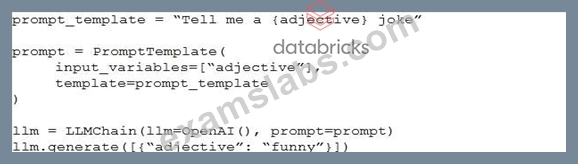
A Generative AI Engineer is testing a simple prompt template in LangChain using the code below, but is getting an error.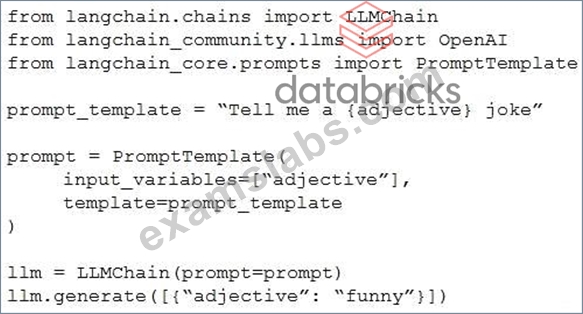
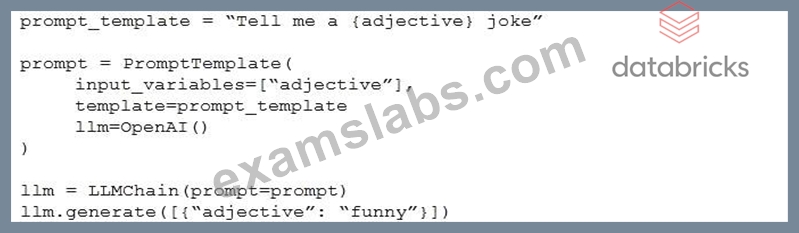
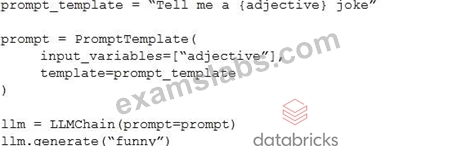
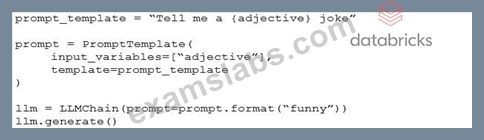
Assuming the API key was properly defined, what change does the Generative AI Engineer need to make to fix their chain?
- A.
- B.
- C.
- D.
Answer: A
Explanation:
To fix the error in the LangChain code provided for using a simple prompt template, the correct approach is Option C. Here's a detailed breakdown of why Option C is the right choice and how it addresses the issue:
* Proper Initialization: In Option C, the LLMChain is correctly initialized with the LLM instance specified as OpenAI(), which likely represents a language model (like GPT) from OpenAI. This is crucial as it specifies which model to use for generating responses.
* Correct Use of Classes and Methods:
* The PromptTemplate is defined with the correct format, specifying that adjective is a variable within the template. This allows dynamic insertion of values into the template when generating text.
* The prompt variable is properly linked with the PromptTemplate, and the final template string is passed correctly.
* The LLMChain correctly references the prompt and the initialized OpenAI() instance, ensuring that the template and the model are properly linked for generating output.
Why Other Options Are Incorrect:
* Option A: Misuses the parameter passing in generate method by incorrectly structuring the dictionary.
* Option B: Incorrectly uses prompt.format method which does not exist in the context of LLMChain and PromptTemplate configuration, resulting in potential errors.
* Option D: Incorrect order and setup in the initialization parameters for LLMChain, which would likely lead to a failure in recognizing the correct configuration for prompt and LLM usage.
Thus, Option C is correct because it ensures that the LangChain components are correctly set up and integrated, adhering to proper syntax and logical flow required by LangChain's architecture. This setup avoids common pitfalls such as type errors or method misuses, which are evident in other options.
NEW QUESTION # 31
A Generative Al Engineer is tasked with developing a RAG application that will help a small internal group of experts at their company answer specific questions, augmented by an internal knowledge base. They want the best possible quality in the answers, and neither latency nor throughput is a huge concern given that the user group is small and they're willing to wait for the best answer. The topics are sensitive in nature and the data is highly confidential and so, due to regulatory requirements, none of the information is allowed to be transmitted to third parties.
Which model meets all the Generative Al Engineer's needs in this situation?
- A. Dolly 1.5B
- B. Llama2-70B
- C. OpenAI GPT-4
- D. BGE-large
Answer: D
Explanation:
Problem Context: The Generative AI Engineer needs a model for a Retrieval-Augmented Generation (RAG) application that provides high-quality answers, where latency and throughput are not major concerns. The key factors areconfidentialityandsensitivityof the data, as well as the requirement for all processing to be confined to internal resources without external data transmission.
Explanation of Options:
* Option A: Dolly 1.5B: This model does not typically support RAG applications as it's more focused on image generation tasks.
* Option B: OpenAI GPT-4: While GPT-4 is powerful for generating responses, its standard deployment involves cloud-based processing, which could violate the confidentiality requirements due to external data transmission.
* Option C: BGE-large: The BGE (Big Green Engine) large model is a suitable choice if it is configured to operate on-premises or within a secure internal environment that meets regulatory requirements.
Assuming this setup, BGE-large can provide high-quality answers while ensuring that data is not transmitted to third parties, thus aligning with the project's sensitivity and confidentiality needs.
* Option D: Llama2-70B: Similar to GPT-4, unless specifically set up for on-premises use, it generally relies on cloud-based services, which might risk confidential data exposure.
Given the sensitivity and confidentiality concerns,BGE-largeis assumed to be configurable for secure internal use, making it the optimal choice for this scenario.
NEW QUESTION # 32
A team wants to serve a code generation model as an assistant for their software developers. It should support multiple programming languages. Quality is the primary objective.
Which of the Databricks Foundation Model APIs, or models available in the Marketplace, would be the best fit?
- A. Llama2-70b
- B. MPT-7b
- C. CodeLlama-34B
- D. BGE-large
Answer: C
Explanation:
For a code generation model that supports multiple programming languages and where quality is the primary objective, CodeLlama-34B is the most suitable choice. Here's the reasoning:
Specialization in Code Generation:
CodeLlama-34B is specifically designed for code generation tasks. This model has been trained with a focus on understanding and generating code, which makes it particularly adept at handling various programming languages and coding contexts.
Capacity and Performance:
The "34B" indicates a model size of 34 billion parameters, suggesting a high capacity for handling complex tasks and generating high-quality outputs. The large model size typically correlates with better understanding and generation capabilities in diverse scenarios.
Suitability for Development Teams:
Given that the model is optimized for code, it will be able to assist software developers more effectively than general-purpose models. It understands coding syntax, semantics, and the nuances of different programming languages.
Why Other Options Are Less Suitable:
A (Llama2-70b): While also a large model, it's more general-purpose and may not be as fine-tuned for code generation as CodeLlama.
B (BGE-large): This model may not specifically focus on code generation.
C (MPT-7b): Smaller than CodeLlama-34B and likely less capable in handling complex code generation tasks at high quality.
Therefore, for a high-quality, multi-language code generation application, CodeLlama-34B (option D) is the best fit.
NEW QUESTION # 33
A Generative Al Engineer is building a RAG application that answers questions about internal documents for the company SnoPen AI.
The source documents may contain a significant amount of irrelevant content, such as advertisements, sports news, or entertainment news, or content about other companies.
Which approach is advisable when building a RAG application to achieve this goal of filtering irrelevant information?
- A. Keep all articles because the RAG application needs to understand non-company content to avoid answering questions about them.
- B. Include in the system prompt that the application is not supposed to answer any questions unrelated to SnoPen Al.
- C. Consolidate all SnoPen AI related documents into a single chunk in the vector database.
- D. Include in the system prompt that any information it sees will be about SnoPenAI, even if no data filtering is performed.
Answer: B
Explanation:
In a Retrieval-Augmented Generation (RAG) application built to answer questions about internal documents, especially when the dataset contains irrelevant content, it's crucial to guide the system to focus on the right information. The best way to achieve this is byincluding a clear instruction in the system prompt(option C).
* System Prompt as Guidance:The system prompt is an effective way to instruct the LLM to limit its focus to SnoPen AI-related content. By clearly specifying that the model should avoid answering questions unrelated to SnoPen AI, you add an additional layer of control that helps the model stay on- topic, even if irrelevant content is present in the dataset.
* Why This Approach Works:The prompt acts as a guiding principle for the model, narrowing its focus to specific domains. This prevents the model from generating answers based on irrelevant content, such as advertisements or news unrelated to SnoPen AI.
* Why Other Options Are Less Suitable:
* A (Keep All Articles): Retaining all content, including irrelevant materials, without any filtering makes the system prone to generating answers based on unwanted data.
* B (Include in the System Prompt about SnoPen AI): This option doesn't address irrelevant content directly, and without filtering, the model might still retrieve and use irrelevant data.
* D (Consolidating Documents into a Single Chunk): Grouping documents into a single chunk makes the retrieval process less efficient and won't help filter out irrelevant content effectively.
Therefore, instructing the system in the prompt not to answer questions unrelated to SnoPen AI (option C) is the best approach to ensure the system filters out irrelevant information.
NEW QUESTION # 34
A Generative Al Engineer is developing a RAG application and would like to experiment with different embedding models to improve the application performance.
Which strategy for picking an embedding model should they choose?
- A. Pick an embedding model trained on related domain knowledge
- B. Pick an embedding model with multilingual support to support potential multilingual user questions
- C. Pick the most recent and most performant open LLM released at the time
- D. pick the embedding model ranked highest on the Massive Text Embedding Benchmark (MTEB) leaderboard hosted by HuggingFace
Answer: A
Explanation:
The task involves improving a Retrieval-Augmented Generation (RAG) application's performance by experimenting with embedding models. The choice of embedding model impacts retrieval accuracy, which is critical for RAG systems. Let's evaluate the options based on Databricks Generative AI Engineer best practices.
Option A: Pick an embedding model trained on related domain knowledge
Embedding models trained on domain-specific data (e.g., industry-specific corpora) produce vectors that better capture the semantics of the application's context, improving retrieval relevance. For RAG, this is a key strategy to enhance performance.
Databricks Reference: "For optimal retrieval in RAG systems, select embedding models aligned with the domain of your data" ("Building LLM Applications with Databricks," 2023).
Option B: Pick the most recent and most performant open LLM released at the time LLMs are not embedding models; they generate text, not embeddings for retrieval. While recent LLMs may be performant for generation, this doesn't address the embedding step in RAG. This option misunderstands the component being selected.
Databricks Reference: Embedding models and LLMs are distinct in RAG workflows: "Embedding models convert text to vectors, while LLMs generate responses" ("Generative AI Cookbook").
Option C: Pick the embedding model ranked highest on the Massive Text Embedding Benchmark (MTEB) leaderboard hosted by HuggingFace The MTEB leaderboard ranks models across general tasks, but high overall performance doesn't guarantee suitability for a specific domain. A top-ranked model might excel in generic contexts but underperform on the engineer's unique data.
Databricks Reference: General performance is less critical than domain fit: "Benchmark rankings provide a starting point, but domain-specific evaluation is recommended" ("Databricks Generative AI Engineer Guide").
Option D: Pick an embedding model with multilingual support to support potential multilingual user questions Multilingual support is useful only if the application explicitly requires it. Without evidence of multilingual needs, this adds complexity without guaranteed performance gains for the current use case.
Databricks Reference: "Choose features like multilingual support based on application requirements" ("Building LLM-Powered Applications").
Conclusion: Option A is the best strategy because it prioritizes domain relevance, directly improving retrieval accuracy in a RAG system-aligning with Databricks' emphasis on tailoring models to specific use cases.
NEW QUESTION # 35
A Generative Al Engineer is working with a retail company that wants to enhance its customer experience by automatically handling common customer inquiries. They are working on an LLM-powered Al solution that should improve response times while maintaining a personalized interaction. They want to define the appropriate input and LLM task to do this.
Which input/output pair will do this?
- A. Input: Customer reviews; Output Group the reviews by users and aggregate per-user average rating, then respond
- B. Input: Customer reviews: Output Classify review sentiment
- C. Input: Customer service chat logs; Output: Find the answers to similar questions and respond with a summary
- D. Input: Customer service chat logs; Output Group the chat logs by users, followed by summarizing each user's interactions, then respond
Answer: C
Explanation:
The task described in the question involves enhancing customer experience by automatically handling common customer inquiries using an LLM-powered AI solution. This requires the system to process input data (customer inquiries) and generate personalized, relevant responses efficiently. Let's evaluate the options step-by-step in the context of Databricks Generative AI Engineer principles, which emphasize leveraging LLMs for tasks like question answering, summarization, and retrieval-augmented generation (RAG).
* Option A: Input: Customer reviews; Output: Group the reviews by users and aggregate per-user average rating, then respond
* This option focuses on analyzing customer reviews to compute average ratings per user. While this might be useful for sentiment analysis or user profiling, it does not directly address the goal of handling common customer inquiries or improving response times for personalized interactions. Customer reviews are typically feedback data, not real-time inquiries requiring immediate responses.
* Databricks Reference: Databricks documentation on LLMs (e.g., "Building LLM Applications with Databricks") emphasizes that LLMs excel at tasks like question answering and conversational responses, not just aggregation or statistical analysis of reviews.
* Option B: Input: Customer service chat logs; Output: Group the chat logs by users, followed by summarizing each user's interactions, then respond
* This option uses chat logs as input, which aligns with customer service scenarios. However, the output-grouping by users and summarizing interactions-focuses on user-specific summaries rather than directly addressing inquiries. While summarization is an LLM capability, this approach lacks the specificity of finding answers to common questions, which is central to the problem.
* Databricks Reference: Per Databricks' "Generative AI Cookbook," LLMs can summarize text, but for customer service, the emphasis is on retrieval and response generation (e.g., RAG workflows) rather than user interaction summaries alone.
* Option C: Input: Customer service chat logs; Output: Find the answers to similar questions and respond with a summary
* This option uses chat logs (real customer inquiries) as input and tasks the LLM with identifying answers to similar questions, then providing a summarized response. This directly aligns with the goal of handling common inquiries efficiently while maintaining personalization (by referencing past interactions or similar cases). It leverages LLM capabilities like semantic search, retrieval, and response generation, which are core to Databricks' LLM workflows.
* Databricks Reference: From Databricks documentation ("Building LLM-Powered Applications," 2023), an exact extract states:"For customer support use cases, LLMs can be used to retrieve relevant answers from historical data like chat logs and generate concise, contextually appropriate responses."This matches Option C's approach of finding answers and summarizing them.
* Option D: Input: Customer reviews; Output: Classify review sentiment
* This option focuses on sentiment classification of reviews, which is a valid LLM task but unrelated to handling customer inquiries or improving response times in a conversational context.
It's more suited for feedback analysis than real-time customer service.
* Databricks Reference: Databricks' "Generative AI Engineer Guide" notes that sentiment analysis is a common LLM task, but it's not highlighted for real-time conversational applications like customer support.
Conclusion: Option C is the best fit because it uses relevant input (chat logs) and defines an LLM task (finding answers and summarizing) that meets the requirements of improving response times and maintaining personalized interaction. This aligns with Databricks' recommended practices for LLM-powered customer service solutions, such as retrieval-augmented generation (RAG) workflows.
NEW QUESTION # 36
A Generative Al Engineer is ready to deploy an LLM application written using Foundation Model APIs. They want to follow security best practices for production scenarios Which authentication method should they choose?
- A. Use OAuth machine-to-machine authentication
- B. Use an access token belonging to service principals
- C. Use an access token belonging to any workspace user
- D. Use a frequently rotated access token belonging to either a workspace user or a service principal
Answer: B
Explanation:
The task is to deploy an LLM application using Foundation Model APIs in a production environment while adhering to security best practices. Authentication is critical for securing access to Databricks resources, such as the Foundation Model API. Let's evaluate the options based on Databricks' security guidelines for production scenarios.
Option A: Use an access token belonging to service principals
Service principals are non-human identities designed for automated workflows and applications in Databricks. Using an access token tied to a service principal ensures that the authentication is scoped to the application, follows least-privilege principles (via role-based access control), and avoids reliance on individual user credentials. This is a security best practice for production deployments.
Databricks Reference: "For production applications, use service principals with access tokens to authenticate securely, avoiding user-specific credentials" ("Databricks Security Best Practices," 2023). Additionally, the "Foundation Model API Documentation" states: "Service principal tokens are recommended for programmatic access to Foundation Model APIs." Option B: Use a frequently rotated access token belonging to either a workspace user or a service principal Frequent rotation enhances security by limiting token exposure, but tying the token to a workspace user introduces risks (e.g., user account changes, broader permissions). Including both user and service principal options dilutes the focus on application-specific security, making this less ideal than a service-principal-only approach. It also adds operational overhead without clear benefits over Option A.
Databricks Reference: "While token rotation is a good practice, service principals are preferred over user accounts for application authentication" ("Managing Tokens in Databricks," 2023).
Option C: Use OAuth machine-to-machine authentication
OAuth M2M (e.g., client credentials flow) is a secure method for application-to-service communication, often using service principals under the hood. However, Databricks' Foundation Model API primarily supports personal access tokens (PATs) or service principal tokens over full OAuth flows for simplicity in production setups. OAuth M2M adds complexity (e.g., managing refresh tokens) without a clear advantage in this context.
Databricks Reference: "OAuth is supported in Databricks, but service principal tokens are simpler and sufficient for most API-based workloads" ("Databricks Authentication Guide," 2023).
Option D: Use an access token belonging to any workspace user
Using a user's access token ties the application to an individual's identity, violating security best practices. It risks exposure if the user leaves, changes roles, or has overly broad permissions, and it's not scalable or auditable for production.
Databricks Reference: "Avoid using personal user tokens for production applications due to security and governance concerns" ("Databricks Security Best Practices," 2023).
Conclusion: Option A is the best choice, as it uses a service principal's access token, aligning with Databricks' security best practices for production LLM applications. It ensures secure, application-specific authentication with minimal complexity, as explicitly recommended for Foundation Model API deployments.
NEW QUESTION # 37
Generative AI Engineer at an electronics company just deployed a RAG application for customers to ask questions about products that the company carries. However, they received feedback that the RAG response often returns information about an irrelevant product.
What can the engineer do to improve the relevance of the RAG's response?
- A. Use a different LLM to improve the generated response
- B. Assess the quality of the retrieved context
- C. Use a different semantic similarity search algorithm
- D. Implement caching for frequently asked questions
Answer: B
Explanation:
In a Retrieval-Augmented Generation (RAG) system, the key to providing relevant responses lies in the quality of the retrieved context. Here's why option A is the most appropriate solution:
* Context Relevance:The RAG model generates answers based on retrieved documents or context. If the retrieved information is about an irrelevant product, it suggests that the retrieval step is failing to select the right context. The Generative AI Engineer must first assess the quality of what is being retrieved and ensure it is pertinent to the query.
* Vector Search and Embedding Similarity:RAG typically uses vector search for retrieval, where embeddings of the query are matched against embeddings of product descriptions. Assessing the semantic similarity searchprocess ensures that the closest matches are actually relevant to the query.
* Fine-tuning the Retrieval Process:By improving theretrieval quality, such as tuning the embeddings or adjusting the retrieval strategy, the system can return more accurate and relevant product information.
* Why Other Options Are Less Suitable:
* B (Caching FAQs): Caching can speed up responses for frequently asked questions but won't improve the relevance of the retrieved content for less frequent or new queries.
* C (Use a Different LLM): Changing the LLM only affects the generation step, not the retrieval process, which is the core issue here.
* D (Different Semantic Search Algorithm): This could help, but the first step is to evaluate the current retrieval context before replacing the search algorithm.
Therefore, improving and assessing the quality of the retrieved context (option A) is the first step to fixing the issue of irrelevant product information.
NEW QUESTION # 38
A Generative Al Engineer is deciding between using LSH (Locality Sensitive Hashing) and HNSW (Hierarchical Navigable Small World) for indexing their vector database Their top priority is semantic accuracy Which approach should the Generative Al Engineer use to evaluate these two techniques?
- A. Compare the Recall-Onented-Understudy for Gistmg Evaluation (ROUGE) scores of returned results for a representative sample of test inputs
- B. Compare the Levenshtein distances of returned results against a representative sample of test inputs
- C. Compare the Bilingual Evaluation Understudy (BLEU) scores of returned results for a representative sample of test inputs
- D. Compare the cosine similarities of the embeddings of returned results against those of a representative sample of test inputs
Answer: D
NEW QUESTION # 39
A Generative AI Engineer just deployed an LLM application at a digital marketing company that assists with answering customer service inquiries.
Which metric should they monitor for their customer service LLM application in production?
- A. Number of customer inquiries processed per unit of time
- B. Final perplexity scores for the training of the model
- C. Energy usage per query
- D. HuggingFace Leaderboard values for the base LLM
Answer: A
Explanation:
When deploying an LLM application for customer service inquiries, the primary focus is on measuring the operational efficiency and quality of the responses. Here's whyAis the correct metric:
* Number of customer inquiries processed per unit of time: This metric tracks the throughput of the customer service system, reflecting how many customer inquiries the LLM application can handle in a given time period (e.g., per minute or hour). High throughput is crucial in customer service applications where quick response times are essential to user satisfaction and business efficiency.
* Real-time performance monitoring: Monitoring the number of queries processed is an important part of ensuring that the model is performing well under load, especially during peak traffic times. It also helps ensure the system scales properly to meet demand.
Why other options are not ideal:
* B. Energy usage per query: While energy efficiency is a consideration, it is not the primary concern for a customer-facing application where user experience (i.e., fast and accurate responses) is critical.
* C. Final perplexity scores for the training of the model: Perplexity is a metric for model training, but it doesn't reflect the real-time operational performance of an LLM in production.
* D. HuggingFace Leaderboard values for the base LLM: The HuggingFace Leaderboard is more relevant during model selection and benchmarking. However, it is not a direct measure of the model's performance in a specific customer service application in production.
Focusing on throughput (inquiries processed per unit time) ensures that the LLM application is meeting business needs for fast and efficient customer service responses.
NEW QUESTION # 40
Which TWO chain components are required for building a basic LLM-enabled chat application that includes conversational capabilities, knowledge retrieval, and contextual memory?
- A. External tools
- B. Conversation Buffer Memory
- C. (Q)
- D. Vector Stores
- E. React Components
- F. Chat loaders
Answer: B,D
Explanation:
Building a basic LLM-enabled chat application with conversational capabilities, knowledge retrieval, and contextual memory requires specific components that work together to process queries, maintain context, and retrieve relevant information. Databricks' Generative AI Engineer documentation outlines key components for such systems, particularly in the context of frameworks like LangChain or Databricks' MosaicML integrations. Let's evaluate the required components:
* Understanding the Requirements:
* Conversational capabilities: The app must generate natural, coherent responses.
* Knowledge retrieval: It must access external or domain-specific knowledge.
* Contextual memory: It must remember prior interactions in the conversation.
* Databricks Reference:"A typical LLM chat application includes a memory component to track conversation history and a retrieval mechanism to incorporate external knowledge"("Databricks Generative AI Cookbook," 2023).
* Evaluating the Options:
* A. (Q): This appears incomplete or unclear (possibly a typo). Without further context, it's not a valid component.
* B. Vector Stores: These store embeddings of documents or knowledge bases, enabling semantic search and retrieval of relevant information for the LLM. This is critical for knowledge retrieval in a chat application.
* Databricks Reference:"Vector stores, such as those integrated with Databricks' Lakehouse, enable efficient retrieval of contextual data for LLMs"("Building LLM Applications with Databricks").
* C. Conversation Buffer Memory: This component stores the conversation history, allowing the LLM to maintain context across multiple turns. It's essential for contextual memory.
* Databricks Reference:"Conversation Buffer Memory tracks prior user inputs and LLM outputs, ensuring context-aware responses"("Generative AI Engineer Guide").
* D. External tools: These (e.g., APIs or calculators) enhance functionality but aren't required for a basicchat app with the specified capabilities.
* E. Chat loaders: These might refer to data loaders for chat logs, but they're not a core chain component for conversational functionality or memory.
* F. React Components: These relate to front-end UI development, not the LLM chain's backend functionality.
* Selecting the Two Required Components:
* Forknowledge retrieval, Vector Stores (B) are necessary to fetch relevant external data, a cornerstone of Databricks' RAG-based chat systems.
* Forcontextual memory, Conversation Buffer Memory (C) is required to maintain conversation history, ensuring coherent and context-aware responses.
* While an LLM itself is implied as the core generator, the question asks for chain components beyond the model, making B and C the minimal yet sufficient pair for a basic application.
Conclusion: The two required chain components areB. Vector StoresandC. Conversation Buffer Memory, as they directly address knowledge retrieval and contextual memory, respectively, aligning with Databricks' documented best practices for LLM-enabled chat applications.
NEW QUESTION # 41
A Generative Al Engineer is building a system that will answer questions on currently unfolding news topics.
As such, it pulls information from a variety of sources including articles and social media posts. They are concerned about toxic posts on social media causing toxic outputs from their system.
Which guardrail will limit toxic outputs?
- A. Log all LLM system responses and perform a batch toxicity analysis monthly.
- B. Use only approved social media and news accounts to prevent unexpected toxic data from getting to the LLM.
- C. Implement rate limiting
- D. Reduce the amount of context Items the system will Include in consideration for its response.
Answer: B
Explanation:
The system answers questions on unfolding news topics using articles and social media, with a concern about toxic outputs from toxic inputs. A guardrail must limit toxicity in the LLM's responses. Let's evaluate the options.
* Option A: Use only approved social media and news accounts to prevent unexpected toxic data from getting to the LLM
* Curating input sources (e.g., verified accounts) reduces exposure to toxic content at the data ingestion stage, directly limiting toxic outputs. This is a proactive guardrail aligned with data quality control.
* Databricks Reference:"Control input data quality to mitigate unwanted LLM behavior, such as toxicity"("Building LLM Applications with Databricks," 2023).
* Option B: Implement rate limiting
* Rate limiting controls request frequency, not content quality. It prevents overload but doesn't address toxicity in social media inputs or outputs.
* Databricks Reference: Rate limiting is for performance, not safety:"Use rate limits to manage compute load"("Generative AI Cookbook").
* Option C: Reduce the amount of context items the system will include in consideration for its response
* Reducing context might limit exposure to some toxic items but risks losing relevant information, and it doesn't specifically target toxicity. It's an indirect, imprecise fix.
* Databricks Reference: Context reduction is for efficiency, not safety:"Adjust context size based on performance needs"("Databricks Generative AI Engineer Guide").
* Option D: Log all LLM system responses and perform a batch toxicity analysis monthly
* Logging and analyzing responses is reactive, identifying toxicity after it occurs rather than preventing it. Monthly analysis doesn't limit real-time toxic outputs.
* Databricks Reference: Monitoring is for auditing, not prevention:"Log outputs for post-hoc analysis, but use input filters for safety"("Building LLM-Powered Applications").
Conclusion: Option A is the most effective guardrail, proactively filtering toxic inputs from unverified sources, which aligns with Databricks' emphasis on data quality as a primary safety mechanism for LLM systems.
NEW QUESTION # 42
A Generative AI Engineer is creating an agent-based LLM system for their favorite monster truck team. The system can answer text based questions about the monster truck team, lookup event dates via an API call, or query tables on the team's latest standings.
How could the Generative AI Engineer best design these capabilities into their system?
- A. Ingest PDF documents about the monster truck team into a vector store and query it in a RAG architecture.
- B. Instruct the LLM to respond with "RAG", "API", or "TABLE" depending on the query, then use text parsing and conditional statements to resolve the query.
- C. Write a system prompt for the agent listing available tools and bundle it into an agent system that runs a number of calls to solve a query.
- D. Build a system prompt with all possible event dates and table information in the system prompt. Use a RAG architecture to lookup generic text questions and otherwise leverage the information in the system prompt.
Answer: C
Explanation:
In this scenario, the Generative AI Engineer needs to design a system that can handle different types of queries about the monster truck team. The queries may involve text-based information, API lookups for event dates, or table queries for standings. The best solution is to implement a tool-based agent system.
Here's how option B works, and why it's the most appropriate answer:
System Design Using Agent-Based Model:
In modern agent-based LLM systems, you can design a system where the LLM (Large Language Model) acts as a central orchestrator. The model can "decide" which tools to use based on the query. These tools can include API calls, table lookups, or natural language searches. The system should contain a system prompt that informs the LLM about the available tools.
System Prompt Listing Tools:
By creating a well-crafted system prompt, the LLM knows which tools are at its disposal. For instance, one tool may query an external API for event dates, another might look up standings in a database, and a third may involve searching a vector database for general text-based information. The agent will be responsible for calling the appropriate tool depending on the query.
Agent Orchestration of Calls:
The agent system is designed to execute a series of steps based on the incoming query. If a user asks for the next event date, the system will recognize this as a task that requires an API call. If the user asks about standings, the agent might query the appropriate table in the database. For text-based questions, it may call a search function over ingested data. The agent orchestrates this entire process, ensuring the LLM makes calls to the right resources dynamically.
Generative AI Tools and Context:
This is a standard architecture for integrating multiple functionalities into a system where each query requires different actions. The core design in option B is efficient because it keeps the system modular and dynamic by leveraging tools rather than overloading the LLM with static information in a system prompt (like option D).
Why Other Options Are Less Suitable:
A (RAG Architecture): While relevant, simply ingesting PDFs into a vector store only helps with text-based retrieval. It wouldn't help with API lookups or table queries.
C (Conditional Logic with RAG/API/TABLE): Although this approach works, it relies heavily on manual text parsing and might introduce complexity when scaling the system.
D (System Prompt with Event Dates and Standings): Hardcoding dates and table information into a system prompt isn't scalable. As the standings or events change, the system would need constant updating, making it inefficient.
By bundling multiple tools into a single agent-based system (as in option B), the Generative AI Engineer can best handle the diverse requirements of this system.
NEW QUESTION # 43
......
Updated Databricks-Generative-AI-Engineer-Associate Dumps Questions For Databricks Exam: https://certificationsdesk.examslabs.com/Databricks/Generative-AI-Engineer/best-Databricks-Generative-AI-Engineer-Associate-exam-dumps.html