

CIPS L4M5 Questions and Answers Guarantee you Oass the Test Easily
Share Latest L4M5 DUMP with 387 Questions and Answers
NEW QUESTION # 156
A buyer is leading a negotiation with a supplier for plumbing parts for a large construction project with a five-year term. The buyer knows copper pipe costs will reduce after year two, while plastic component costs are forecast to rise significantly. In the negotiation, the buyer should seek to...
- A. Fix the costs of all components for the full five years
- B. Obtain a variable cost for copper and fix the remaining cost components
- C. Obtain a variable price for all components within the contract
- D. Fix the costs of the components within the contract after the third year
Answer: B
Explanation:
Effective negotiation preparation requires buyers to align pricing mechanisms with cost forecasts and risk exposure. Since copper prices are forecast to fall, fixing them would disadvantage the buyer; a variable price allows the buyer to benefit from market reductions. Conversely, where plastic component costs are expected to rise, fixing prices protects the buyer from inflationary increases. CIPS highlights the importance of selectively applying fixed and variable pricing to manage risk intelligently rather than adopting a single approach across all components. This mixed strategy demonstrates strong commercial awareness and supports value-for-money outcomes over long-term contracts.
Reference: CIPS L4M5 Commercial Negotiation (CORE), 2nd edition - LO 2.2: Pricing arrangements, cost forecasting, and risk management in negotiation preparation.
NEW QUESTION # 157
Which of the following are most likely to be fixed costs of an airline? Select TWO that apply.
- A. Advertising and promotion
- B. Catering services
- C. Fuel
- D. Flight crew training
- E. Purchase of aircraft
Answer: D,E
Explanation:
Fixed costs (FC) are costs that do not vary with volume. To an airline once aircraft are purchased, flight crews trained and departures scheduled, costs are disproportionately fixed.
Variable costs (VC) are those which vary with the amount produced. Fuel, catering services and marketing are examples of variable.
LO 2, AC 2.1
NEW QUESTION # 158
Effective listening is important in integrative negotiations. Is this statement correct?
- A. No, as effective listening is important only in a distributive negotiation
- B. No, as what the other party has to say is not important
- C. Yes, as it means the supplier's attempts at negotiation can be stopped quickly with reasoning
- D. Yes, as it allows issues to be shared and understood between all parties
Answer: D
Explanation:
Effective listening is crucial in integrative negotiations because it promotes understanding and collaboration.
By actively listening, parties can identify shared interests and address concerns, which supports the goal of reaching mutually beneficial solutions. This is a key component in CIPS guidelines on successful integrative negotiation practices.
NEW QUESTION # 159
Which of the following are examples of variable costs?
* Building and site rent
* Annual insurance premium
* Raw materials expenditure
* Delivery costs for materials
- A. 2 and 3
- B. 1 and 3
- C. 1 and 4
- D. 3 and 4
Answer: D
Explanation:
Variable costs fluctuate with production volume - e.g., raw materials and delivery costs. Fixed costs such as rent and insurance remain constant regardless of output. In negotiations, suppliers may inflate fixed cost allocations to justify pricing; buyers should differentiate between fixed and variable costs to challenge pricing more effectively. Recognising true variable costs also allows negotiating for volume-related discounts.
Reference: CIPS L4M5 (2nd ed.), LO 2.2 - Cost structure: variable vs fixed costs in pricing analysis.
NEW QUESTION # 160
Which of the following is a source of information on microeconomic factors?
- A. Published economic indices such as the Retail Price Index (RPI)
- B. The marketing and corporate communications of suppliers
- C. Analysis published in the mainstream and financial media
- D. Data published by the financial markets and commodity markets and exchanges
Answer: D
Explanation:
Microeconomic data specific to industries, suppliers, or products can often be found in commodity markets, trade exchanges, and financial databases. These provide detailed insights on supply, demand, pricing, and trends.
Reference: L4M5 Commercial Negotiation 2nd edition (CORE), Section 2.2 - Information Sources for Market and Economic Analysis
NEW QUESTION # 161
The trust is built based on the other party's professional qualifications or proven or certified technical capability or experience is known as...?
- A. Goodwill trust
- B. Competence trust
- C. Contractual trust
- D. Irrevocable Trust
Answer: B
Explanation:
Trust is the expectation that the other party will behave in a predictable and mutually acceptable way. In inter-firm relationships, the presence and absence of trust can affect the level of cost in a relationship. The existence of trust is taught to lower the transaction cost in a relationship. Dr. Mari Sako identified taxonomy of
3 types of trust in commercial relationship, which is very useful from the perspective of procurement.
Contractual trust: Trust based on the contract with TOP. This is potentially the weakest source of trust if there is nothing else to base the trust on, but it is the quickest to establish.
Competence trust: Trust based on TOP's professional qualifications or proven or certified technical capability or experience.
Goodwilltrust: Trust based on knowing TOP has your interest at heart and will not behave opportunistically.
This is potentially the strongest type of trust, but it takes the longest time to build.
NEW QUESTION # 162
Which of the following are examples of push techniques in commercial negotiations? Select TWO that apply.
- A. Threat of punishment, costs and damage
- B. Working together to define the problem, the goals and the best solution
- C. Listening to, involving andsupporting others
- D. Argument based on information, logic and reason
- E. Using language and imagery to 'paint a picture others can see'
Answer: A,D
Explanation:
There are two major persuasion methods: 'push' and 'pull'.
Persuasion can be defined as encouraging someone to do something that you want them to do for you.
Persuasion is reasoning with someone so that they will believe or do something they might not otherwise do.
Persuasion can be considered as 'pushing' on TOP so that they can accept the change in attitude or behaviour as a result of your actions.
Influence is the ability to affect the manner of thinking of another. Influence can be considered as pulling on TOP so that you achieve the same result, but TOP feels they have changed their attitude or behaviour as a result of their reflection and thinking, and not your direct actions.
There are 5 options in this question:
'Threat of punishment, costs and damage': The influencertries to 'push' the other party to act as he/she wants by using force. This method is effective but short-lived. The influencer also risks to developing reputation for being heavy handed and dictatorial.
'Argument based on information, logic and reason':The influencer uses logic and reasons to persuade the other party. This is also known as 'Persuasive Reasoning' (Push)
'Using language and imagery to 'paint a picture others can see'': The influencer seeks to influence another by understanding the other'semotions, and stimulating that party's imagination to visualise the desired future goal of the influencer. This is also known as 'visionary (pull)'
'Working together to define the problem, the goals and the best solution': In this technique, the person seeking to influence another involves the other party in the decision making process. This is known as 'collaborative (pull)'
'Listening to, involving and supporting others': In this technique, the person seeking to influence another tries to discover the other party's emotion and aims at mutual understanding. This is also a collaborative approach.
NEW QUESTION # 163
Which of the following is a description of mark-up?
- A. Profit expressed as a percentage of variable costs
- B. Profit expressed as a percentage of costs
- C. Profit expressed as a percentage of fixed costs
- D. Profit expressed as a percentage of the selling price
Answer: B
Explanation:
Mark-up is defined as profit expressed as a percentage of the cost. It calculates the profit margin based on the cost price rather than the selling price, which allows companies to determine how much they are earning over their production or purchase costs. This aligns with standard accounting and CIPS definitions of mark-up in procurement contexts.
NEW QUESTION # 164
When engaging in commercial negotiations, it is important to bear in mind that the suppliers need to make a reasonable profit to maintain continuity of supply. It is therefore necessary for the buyer to have a clear understanding of the break-even analysis concept which relates to cost, volume, and profit.
What is 'contribution' in relation to break-even analysis?
- A. The gains that the supplier receives when the sales revenue exceeds fixed costs
- B. The gains that the supplier receives when the sales revenue exceeds variable costs
- C. The gains from sales revenue which the supplier retains as reserves to contribute to future development projects
- D. The gains from sales revenue that the supplier is willing to contribute in a profit-sharing contractual arrangement
Answer: B
Explanation:
Inbreak-even analysis,contributionrefers to the amount from sales revenue that exceedsvariable costs, which then contributes to coveringfixed costsand ultimately generating profit. Understanding this concept enables buyers to better analyze supplier pricing and negotiate more effectively. For example, if a product is priced significantly above its variable cost, there may be room fordiscounts or added value, as the supplier is still contributing toward fixed costs.
Reference: L4M5 Commercial Negotiation 2nd edition (CORE), Section 2.1 - Cost Analysis and Pricing Decisions
NEW QUESTION # 165
Sunita's supplier states: "Meeting your needs is meeting my needs because we are in this together." What type of negotiation is being undertaken?
- A. Adversarial negotiation
- B. Distributive negotiation
- C. Lose-lose negotiation
- D. Integrative negotiation
Answer: D
Explanation:
This statement reflects shared goals and mutual benefit, hallmarks of integrative negotiation. Unlike adversarial or distributive (win-lose) strategies, integrative approaches seek joint value and collaboration. The language of partnership ("we are in this together") signals alignment and cooperative intent. Lose-lose outcomes, by contrast, occur when both sides compromise excessively or fail to reach creative solutions.
Integrative strategies foster long-term partnerships where value is maximised for both.
Reference: CIPS L4M5 (2nd ed.), LO 1.1 - Integrative negotiation characteristics.
NEW QUESTION # 166
A competitive win-lose distributive approach to a negotiation is seeking to:
- A. Foster collaboration and trust between the parties to enable joint problem solving
- B. Obtain the largest possible share of resources or benefits at the expense of the other party
- C. Maximise joint gains for both parties so that resources and benefits are equally shared
- D. Compromise and split the difference so that both parties do not get what they want
Answer: B
NEW QUESTION # 167
Which of the following is a source of information on microeconomic factors?
- A. Published economic indices such as the Retail Price Index (RPI)
- B. The marketing and corporate communications of suppliers
- C. Analysts published in the mainstream and financial media
- D. Data published by the financial markets and commodity markets and exchanges
Answer: D
Explanation:
Reference: CIPS L4M5 Study Guide, Section 2.3 - Market Factors and Analysis
NEW QUESTION # 168
Where can we find the data on macroeconomics?
1. From trade journal
2. From supplier's marketing catalogue
3. From stock exchange market
4. From government's statistics
- A. 1 and 3 only
- B. 2 and 4 only
- C. 3 and 4 only
- D. 1 and 2 only
Answer: C
Explanation:
Macroeconomic indicators are statistics or data readings that reflect the economic circumstances of a particular country, region or sector. They are used by analysts and governments to assess the current and future health of the economy and financial markets.
Macroeconomic indicators will vary in their meaning and the impact that they have on the economy, but broadly speaking there are two main types of indicator.
- Leading indicators, which forecast where an economy might be heading. They are often used by governments to implement policies because they represent the first phase of a new economic cycle. These include the yield curve, interest rates and share prices.
- Lagging indicators, which reflect an economy's historical performance and only change after a trend has been established. They are used to confirm a trend is underway. These include gross domestic product (GDP), inflation and employment figures.
There is also the category of coincident indicators, but these are generally grouped in with lagging indicators as they either happen at the same time or after an economic shift.
The best macroeconomic indicator to watch will heavily depend on your personal preferences, what positions you are taking and which country your portfolio is focused on. However, there are some very common indicators that most traders and investors will keep an eye on.
For simplicity's sake, we have split these out into leading and lagging indicators.
Top leading indicators:
1. The stock market
2. House prices
3. Bond yields
4. Production and manufacturing statistics
5. Retail sales
6. Interest rates
Top lagging indicators:
1. GDP growth rates
2. The Consumer Price Index (CPI) and inflation
3. Currency strength and stability
4. Labour market statistics
5. Commodity prices
A procurement professional may find stock market data from the security exchange, while most lagging indicators (such as GDP, CPI, unemployment rate, currency and inflation rate, etc) can be found from government statistics data.
Reference:
- CIPS study guide page 117-118
- What Are the Key Macroeconomic Indicators?| IG EN
LO 2, AC 2.2
NEW QUESTION # 169
Which type of question should be used to receive affirmation on statement?
- A. Open
- B. Leading
- C. Closed
- D. Narrow
Answer: C
Explanation:
Different questioning styles can be used to elicit desired responses:
Text Description automatically generated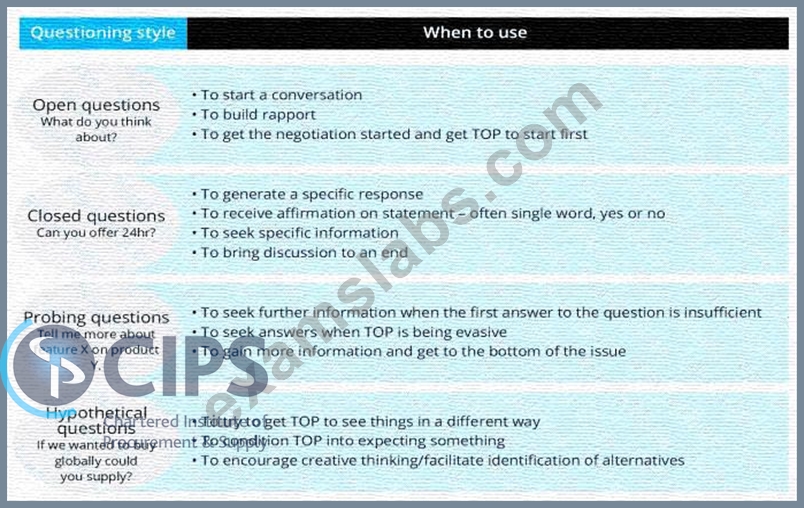
NEW QUESTION # 170
Which of the following is the definition of safety margin?
- A. The production level at which total revenues for a product equal total expenses
- B. The incremental money generated for each product/unit sold after deducting the variable costs
- C. The amount of revenue that remains after subtracting costs directly associated with production
- D. The difference between current or forecasted sales and sales at the break-even point
Answer: D
Explanation:
:
As a financial metric, the margin of safety (safety margin) is equal to the difference between current or forecasted sales and sales at the break-even point. The margin of safety is sometimes reported as a ratio, in which the aforementioned formula is divided by current or forecasted sales to yield a percentage value. The figure is used in both break-even analysis and forecasting to inform a firm's management of the existing cushion in actual sales or budgeted sales before the firm would incur a loss.
This is a question that a student met in her actual exam. The margin of safety is not even mentioned in the CIPS study guide.
NEW QUESTION # 171
......
CIPS L4M5: Commercial Negotiation exam is designed to prepare candidates for effective negotiation practices in the purchasing industry. L4M5 exam assesses a candidate's ability to identify key factors in a negotiation process, interpret and apply negotiation theories, and employ negotiation strategies. Candidates will be required to showcase their understanding of informed decision-making, developing and maintaining relationships, and the management of the negotiation process.
Dumps for Free L4M5 Practice Exam Questions: https://certificationsdesk.examslabs.com/CIPS/CIPS-Level-4-Diploma-in-Procurement-and-Supply/best-L4M5-exam-dumps.html