

[Jul 22, 2026] Genuine AB-410 Exam Dumps Free Demo
Printable & Easy to Use Microsoft Certified: Dynamics 365 Sales AI Consultant Associate AB-410 Dumps 100% Same Q&A In Your Real Exam
NEW QUESTION # 45
A company wants an AI system to analyze customer reviews and determine whether opinions are positive, negative, or neutral. Which Azure AI capability is most appropriate?
- A. Object detection
- B. Sentiment analysis
- C. Document conversion
- D. Speech synthesis
Answer: B
Explanation:
Sentiment analysis is a natural language processing capability used to determine emotional tone within text. It can classify opinions and provide confidence scores. Object detection analyzes images, speech synthesis generates audio, and document conversion changes formats. Review analysis is a common business scenario for sentiment analysis.
NEW QUESTION # 46
You need to implement a generative AI solution that meets the requirements.
Which two actions should you perform? Each correct answer presents part of the solution. NOTE: Each correct selection is worth one point.
- A. Start from a blank prompt.
- B. Use a custom model.
- C. Use a pre-built model.
- D. Create a prompt from a template.
Answer: A,C
Explanation:
The solution should use a prebuilt AI capability where it satisfies the complaint-processing requirement and create the generative prompt from blank for the organization-specific inspection report. Using a prebuilt model minimizes custom model development and training effort, which directly reflects the stated constraint.
A blank custom prompt gives the maker control over the inspection template, instructions, inputs, tone, and output format required by the business. Starting from a prompt template can accelerate common scenarios, but the case requires alignment to an existing custom inspection format; a blank prompt avoids carrying irrelevant template assumptions and permits deliberate grounding. Building a custom trained model would add data preparation, training, validation, and lifecycle overhead that the requirement seeks to minimize. The prompt should define required inputs explicitly and be tested with representative data to prevent the inconsistent output problem identified in the case. The Study Guide covers "build prompts from templates or from blank,"
"add inputs to a prompt," and consumption of AI capabilities in apps and flows. Options A and C provide the lowest-custom-development design that still supports the specific generative output.
Study Guide reference/topic: "Create prompts and models in AI Hub - Build prompts and consume AI capabilities." AB-410 Study Guide | Microsoft Learn technical reference
NEW QUESTION # 47
A company uses Dataverse to configure derived values for sales records.
The company requires the following functionality:
# Evaluate an expression by using numerical columns in the same row.
# Calculate the result dynamically when accessed.
# Ensure the result is NOT stored as part of the table data.
The solution must minimize use of custom code.
You need to configure the app.
What should you do?
- A. Use a real-time workflow to update the value.
- B. Use a business rule to populate the value.
- C. Use a plugin to calculate.
- D. Create a formula column.
Answer: D
Explanation:
A formula column is designed for a dynamically derived value based on columns in the same Dataverse row.
The maker defines a Power Fx expression using the numerical source columns, and Dataverse exposes the result as a read-only calculated value when it is requested. The formula definition is maintained rather than a manually populated result column, so the application does not need a background job to keep the value synchronized. A real-time workflow or business rule would write a value into stored data and would have to run again whenever an input changes. A plug-in can calculate a value during a transaction or retrieval, but it introduces custom server-side code and deployment overhead that the requirement specifically asks to minimize. The formula must use supported data types and functions, and makers should consider precision, blank values, and division-by-zero behavior. Microsoft's formula-column documentation describes these columns as displaying calculated Dataverse values through Power Fx. The Study Guide includes "configure calculated, rollup, and formula columns." Option A is therefore the native low-code choice for the same-row dynamic calculation.
Study Guide reference/topic: "Implement business and process logic - Configure formula columns." AB-
410 Study Guide | Microsoft Learn technical reference
NEW QUESTION # 48
A company uses Dataverse to manage customer accounts and related transaction records.
The company requires the following functionality:
- Reference a single related record without performing any
aggregations.
- Store the relationship as part of the table definition, so the
platform automatically maintains the link between records.
You need to configure a column.
Which type of column should you configure?
- A. Lookup
- B. Formula
- C. Calculated
- D. Rollup
Answer: A
Explanation:
A Lookup column is the best fit for the requirements.
A Lookup column specifically establishes a direct, unaggregated relationship between two records. By adding a Lookup column to a table, Dataverse automatically defines a formal one-to- many table relationship, ensuring the platform consistently maintains the link and enforces data integrity.
Reference:
https://www.esamatic.it/technologies/power-platform/dataverse/relationships
NEW QUESTION # 49
Note: This question is part of a series of questions that present the same scenario. Each question in the series contains a unique solution that might meet the stated goals. Some question sets might have more than one correct solution, while others might not have a correct solution.
After you answer a question in this section, you will NOT be able to return to it. As a result these questions will not appear on the review screen.
A company integrates external systems into Power Automate by using cloud flows.
The company must connect to external services with different characteristics and determine whether a custom connector is required.
You need to evaluate if a custom connector is necessary to meet the requirements.
Solution: A cloud flow must integrate with an internal web service that is used across multiple flows and requires reusable actions.
Does the solution meet the goal?
- A. Yes
- B. No
Answer: A
Explanation:
Correct:
* A cloud flow must integrate with an internal web service that is used across multiple flows and requires reusable actions.
This scenario requires a custom connector. Because it is a proprietary or internal service, Microsoft does not provide a pre-built native bridge. Building a Microsoft Custom Connector wraps the web service's REST/SOAP API into a reusable tool, eliminating the need to repeatedly configure HTTP headers and endpoints across separate flows.
Incorrect:
* A cloud flow must call a REST API by using a one-time HTTP action without reuse across flows.
A custom connector is not necessary here. For single-use or non-reusable integrations, using a generic built-in HTTP action step is the most efficient and fastest choice.
* A cloud flow must retrieve data from Microsoft Dataverse.
Power Automate includes a native, out-of-the-box Microsoft Dataverse connector. There is no need to develop a custom connector for default Power Platform data storage.
* A cloud flow must retrieve data from SharePoint Online lists.
SharePoint Online is fully supported by native Microsoft 365 integrations. You should use the pre- built SharePoint connector instead of creating a custom wrapper.
Reference:
https://alphavima.com/blog/power-apps-custom-connector-rest-api/
NEW QUESTION # 50
A company is using Microsoft Dataverse.
You must integrate Dataverse with a third-party AI service. The solution requires authentication and custom request handling to send and receive data.
You need to enable the integration.
What should you do?
- A. Use Microsoft 365 Copilot chat.
- B. Create a custom connector.
- C. Configure an environment variable.
- D. Use Power Fx.
Answer: B
Explanation:
A custom connector is required to integrate with the third-party AI service because the integration needs a defined authentication scheme and custom request handling. The connector wraps the service's API as named operations, with host information, paths, methods, headers, parameters, request bodies, and response schemas.
Power Automate or Power Apps can then call those operations through governed connections instead of reconstructing raw requests in every solution. Power Fx is an expression language and does not by itself define or secure an external API contract. Microsoft 365 Copilot chat is a user productivity experience, not a Dataverse integration mechanism. An environment variable can store deployment-specific configuration such as a base URL or identifier, but it neither authenticates nor sends the API request. The connector should be packaged in a solution, use the service's supported API key or OAuth design, and comply with data loss prevention policies. This directly aligns with the Study Guide cloud-flow objective "evaluate and recommend connectors" and Microsoft's custom connector architecture.
Study Guide reference/topic: "Create cloud flows - Evaluate and recommend connectors." AB-410 Study Guide | Microsoft Learn technical reference
NEW QUESTION # 51
A company maintains an AI-enabled Power Platform solution that includes prompts, cloud flows, and Dataverse components. The solution is deployed to a production environment.
The company requires the following updates to the solution:
- New features must be released regularly.
- Updates must be validated before release.
- Deployed updates must be able to be removed from production if
necessary.
You need to update the solution while maintaining release control and following Microsoft best practices.
What should you do?
- A. Update the development environment. Run solution checker.
- B. Update the development environment. Deploy the solution as managed.
- C. Update the development environment. Deploy the solution as unmanaged.
- D. Modify the development customizations file. Deploy to production.
Answer: B
Explanation:
Modifying the development environment and deploying the solution as managed is the correct action and aligns with Microsoft best practices.
Ability to Remove Deployed Updates: Importing a solution as managed allows you to cleanly uninstall the solution later if a rollback is necessary. Uninstalling a managed solution completely removes all its associated components (prompts, cloud flows, and Dataverse tables) from the production environment, whereas updating with unmanaged solutions results in additive-only changes that cannot be automatically deleted upon removal.
Reference:
https://learn.microsoft.com/en-us/power-platform/alm/organize-solutions
NEW QUESTION # 52
A company is using Microsoft Dataverse.
You must integrate Dataverse with a third-party AI service. The solution requires authentication and custom request handling to send and receive data.
You need to enable the integration.
What should you do?
- A. Use a classic workflow.
- B. Create a custom connector.
- C. Use an AI Builder model.
- D. Configure an environment variable.
Answer: B
Explanation:
Use a Custom Connector. It is built specifically to wrap REST APIs and natively supports the required custom request handling and authentication needed to send and receive data with third- party AI services.
Reference:
https://learn.microsoft.com/en-us/connectors/commondataserviceforapps/
NEW QUESTION # 53
A company uses Microsoft Dataverse to store customer records on the Account table. A business process flow is configured for the table.
The company requires a Power Automate cloud flow that validates and corrects the format of the customer account number. The Power Automate flow must run whenever data in this field changes.
You need to recommend a trigger for the cloud flow.
Which trigger should you recommend?
- A. When a row is added, modified or deleted
- B. When a row is selected
- C. When an action is performed
- D. When a flow step is run from a business process flow
Answer: A
Explanation:
The cloud flow trigger should fire when a row is modified, specifically targeted to the Account table, with the "Select columns" (column filter) parameter set to the logical name of the customer account number column.
Correct Trigger Configuration
Connector: Microsoft Dataverse
Trigger: When a row is added, modified or deleted
Change type: Modified (or Added or Modified if you also need to check the format upon record creation) Table name: Accounts Reference:
https://learn.microsoft.com/en-us/power-automate/dataverse/overview
NEW QUESTION # 54
Note: This question is part of a series of questions that present the same scenario. Each question in the series contains a unique solution that might meet the stated goals. Some question sets might have more than one correct solution, while others might not have a correct solution.
After you answer a question in this section, you will NOT be able to return to it. As a result these questions will not appear on the review screen.
A company integrates external systems into Power Automate by using cloud flows.
The company must connect to external services with different characteristics and determine whether a custom connector is required.
You need to evaluate if a custom connector is necessary to meet the requirements.
Solution: A cloud flow must retrieve data from SharePoint Online lists.
Does the solution meet the goal?
- A. Yes
- B. No
Answer: B
Explanation:
A custom connector is not required because SharePoint Online already has a Microsoft-supported connector.
The SharePoint connector exposes triggers for list-item creation or modification and actions such as Get item and Get items for retrieving list data. Authentication and connection management are handled through the standard connector, and its operations participate in environment connection references and data policies. A custom connector is appropriate when no suitable prebuilt connector exists or when proprietary API operations, schemas, and authentication must be exposed. Recreating normal SharePoint list operations as a custom connector would add API definition, testing, governance, and maintenance without adding required capability. The flow should select the standard action that matches whether one item or a filtered collection is needed and should use OData filtering or pagination for larger lists. The AB-410 Study Guide places this decision under "evaluate and recommend connectors." Because a supported SharePoint connector already meets the requirement, the proposed situation does not make a custom connector necessary. The correct response is No.
Study Guide reference/topic: "Create cloud flows - Evaluate and recommend connectors." AB-410 Study Guide | Microsoft Learn technical reference
NEW QUESTION # 55
You are modifying a model-driven app. You set up a customer table in Microsoft Power Platform to retrieve user data.
You set up a form with the following columns for users to enter their data .
The form includes the following columns:
The form must do the following:
# The Country/region column must automatically populate with US when English is chosen as a language. If the user selects Other for this column, the column must remain blank so that user can enter a value.
# The Passport expiration date column must appear only if the user selects Yes in the Passport ownership column.
You need to configure the app with the least amount of effort.
What should you configure? To answer, drag the appropriate solution component to the correct requirements.
Each solution component may be used once, more than once, or not at all. You may need to drag the split bar between panes or scroll to view content. NOTE: Each correct selection is worth one point.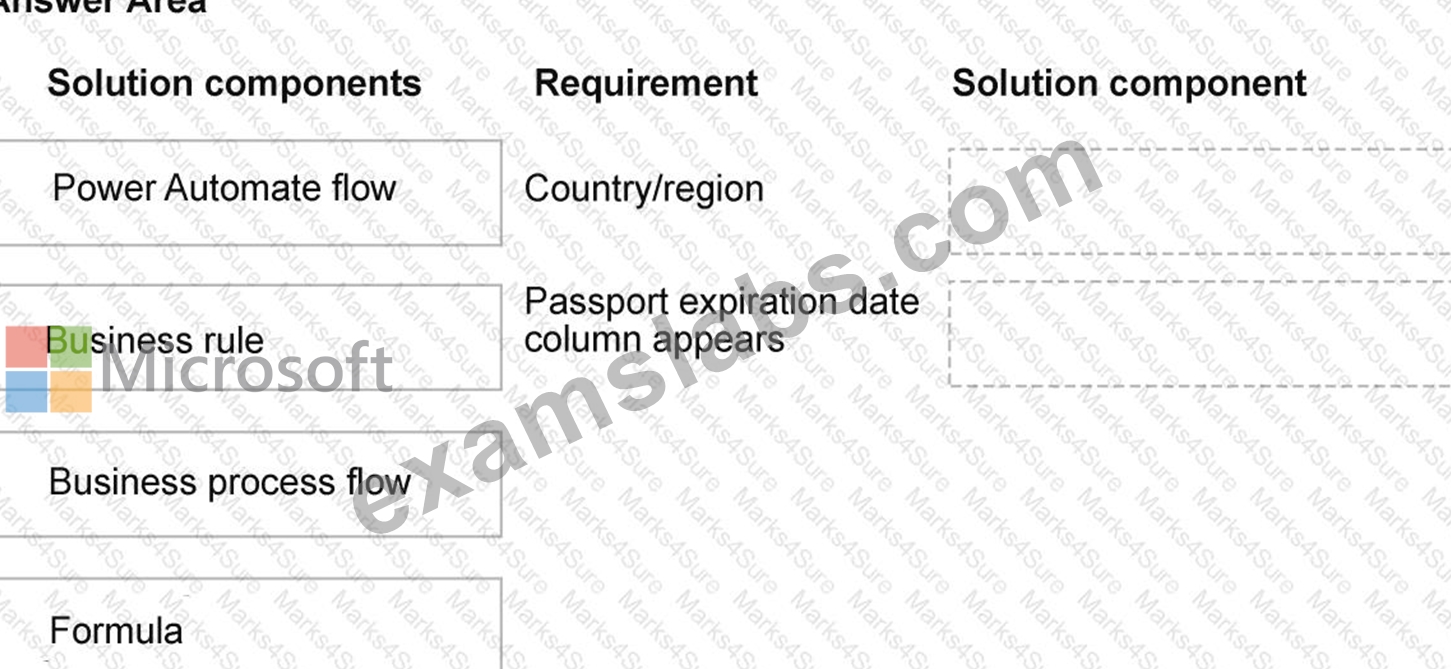
Answer:
Explanation: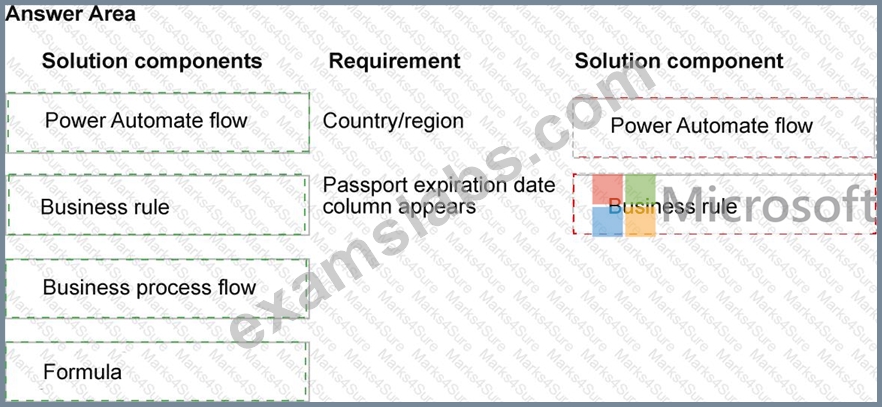
Explanation:
Country/region population - Power Automate flow; Passport expiration visibility - Business rule The Country/region population should use a Power Automate flow, while passport-expiration visibility should use a business rule. A flow triggered by the row change can inspect the selected language values, set US when English is present, and leave Country/region blank when Other is selected. The passport requirement is ordinary form behavior: when Passport ownership equals Yes, a business rule can show the expiration-date control; otherwise it can hide it. That gives immediate client-side feedback with minimal code. The original embedded answer image assigns both requirements to business rules; it is preserved unchanged, but the verified first mapping is Power Automate flow. The flow must avoid a trigger loop by filtering changed columns or checking whether an update is necessary. The Study Guide covers business rules, cloud-flow triggers, and business-logic use-case evaluation. The corrected mapping respects both feature support and execution timing.
Study Guide reference/topic: "Implement business and process logic - Configure business rules and flows." AB-410 Study Guide | Microsoft Learn technical reference
NEW QUESTION # 56
Drag and Drop Question
A company processes transaction records by using a Power Automate cloud flow.
The company has the following requirements:
- Continue processing records until a status field changes to Complete, even if new records are added during execution.
- Process a fixed list of records retrieved at the start of the flow,
ensuring each record is processed exactly once.
You need to configure the flow control logic.
Which controls should you use? To answer, move the appropriate controls to the correct requirements. You may use each control once, more than once, or not at all. You may need to move the split bar between panes or scroll to view content.
NOTE: Each correct selection is worth one point.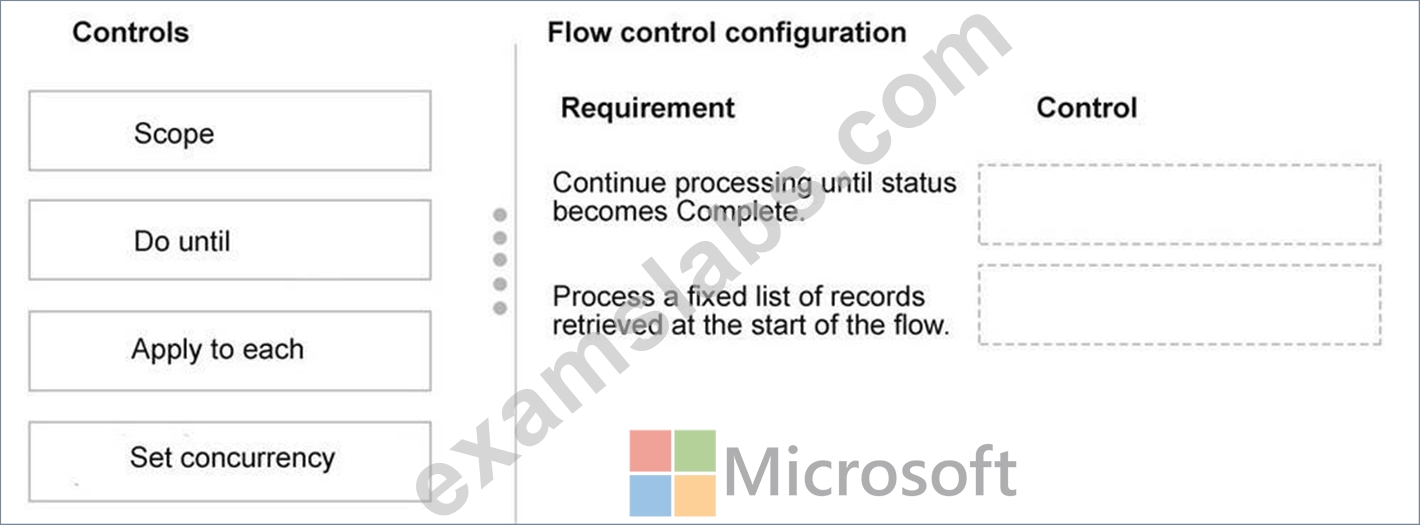
Answer:
Explanation: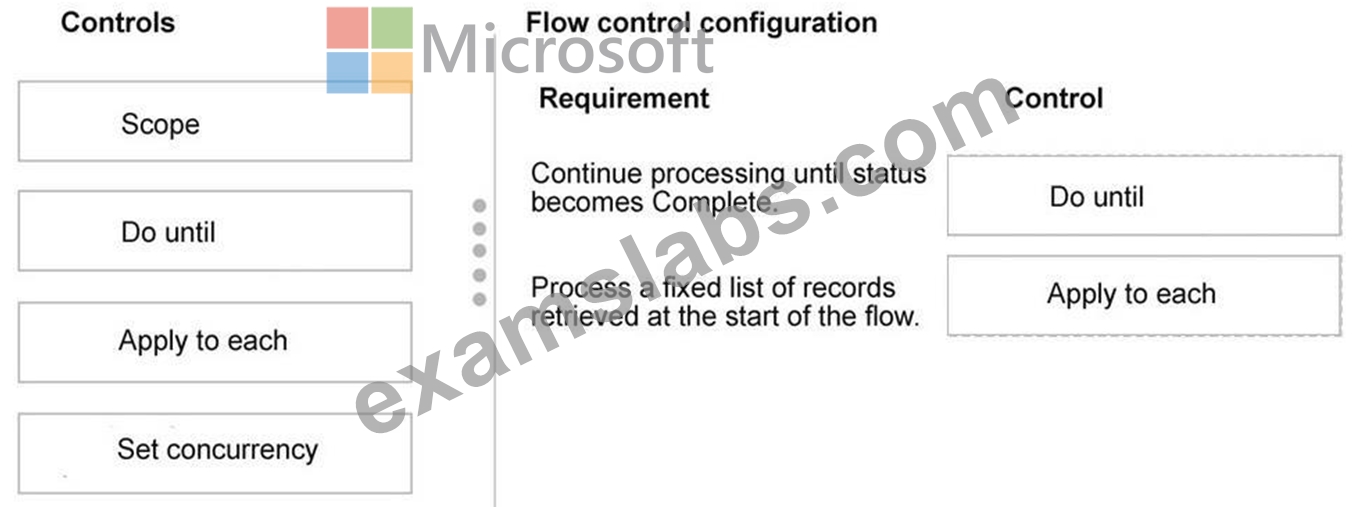
Explanation:
Box 1: Do until
A Do Until control logic is perfectly suited for this Power Automate cloud flow requirement. It allows the flow to continuously loop and process records dynamically, meaning if new items are continuously added to the queue during execution, the loop will catch and process them as long as the data is retrieved dynamically inside every iteration.
Box 2: Apply to each
Use the "Apply to each" control action. It takes the fixed array (list of records) you retrieved at the start of your flow and processes the records one by one.
Reference:
https://learn.microsoft.com/en-us/azure/logic-apps/logic-apps-control-flow-loops
https://learn.microsoft.com/en-us/power-automate/apply-to-each
NEW QUESTION # 57
A company plans to implement an automated process to retrieve and analyze customer feedback.
The company requires a solution that:
# Autonomously analyzes feedback.
# Stores results for reporting.
# Triggers an escalation for negative sentiment.
You need to design the solution.
Which three components should you use? Each correct answer presents part of the solution. NOTE: Each correct selection is worth one point. (Choose three.)
- A. Cloud flow
- B. Dataverse table
- C. Canvas app
- D. Business rule
- E. AI builder prompt
Answer: A,B,E
Explanation:
The solution requires an AI Builder prompt, a cloud flow, and a Dataverse table. The prompt performs the autonomous semantic analysis of each feedback item, including sentiment or other instructed classifications.
The cloud flow supplies the event-driven orchestration: it retrieves new feedback, calls the prompt, interprets the result, writes the output, and branches to an escalation action when sentiment is negative. Dataverse provides persistent, queryable storage for the original feedback, model result, status, and reporting fields. A canvas app may be useful for reviewing results but is not required for autonomous execution. A business rule can validate or adjust Dataverse data but cannot independently call the generative model and orchestrate external escalation. The flow should include explicit failure handling, confidence or result validation, and an idempotent design so retries do not create duplicate escalations. Approved data policies must also permit the connectors used by the flow. The Study Guide covers "consume a prompt in cloud flows," "configure cloud flow actions," and the creation of Dataverse-backed business solutions. A, B, and E form the complete analysis, automation, and persistence architecture.
Study Guide reference/topic: "Create cloud flows; Create prompts and models in AI Hub." AB-410 Study Guide | Microsoft Learn technical reference
NEW QUESTION # 58
Hotspot Question
You are configuring a dashboard in a model-driven app for sales managers. The dashboard displays opportunity pipeline data from the Opportunities table.
The company requires the following functionality:
- Show how each sales stage contributes to the total pipeline for each
sales region.
- Ensure a newly created chart is available to users in the app.
- Use the My Open Opportunities dataset when the dashboard component
loads.
- Prevent users from switching to a different chart at runtime.
You need to create and configure the chart and dashboard component.
How should you configure the requirements? To answer, select the appropriate options in the answer area.
NOTE: Each correct selection is worth one point.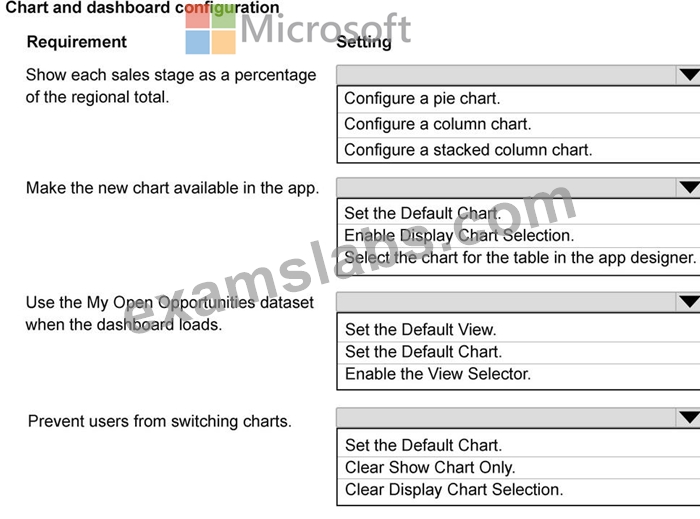
Answer:
Explanation: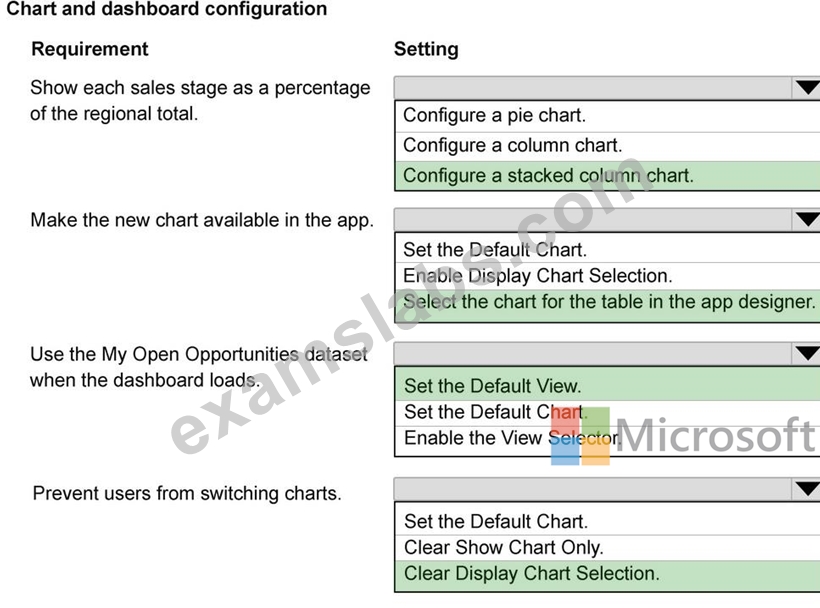
Explanation:
Box 1: Configure a stacked column chart.
To show how each sales stage contributes to the total pipeline for each sales region, you need to create a Stacked Column or Stacked Bar chart on the Opportunities table and add it to a dashboard.
Box 2: Select the chart for the table in the app designer
To ensure the newly created chart is available to sales managers in the model-driven app, you must select the chart for the table in the app designer.
In Power Apps model-driven apps, assets like tables, views, forms, and charts are not automatically included in an app just because they exist in the Dataverse environment.
The App Designer Rule: You must explicitly check the box next to your new chart under the Opportunity table components within the App Designer. If it is not selected there, users will not be able to see or interact with it inside that specific app.
The Dashboard Component: When you add a chart component to a dashboard, you also configure its properties. While "Enable Display Chart selection" allows users to toggle between different charts on the dashboard, the chart itself must still be a part of the app's included components to function correctly.
Box 3: Set the Default View
To set the "My Open Opportunities" dataset as the default view when your dashboard loads, you must configure the Default View property for the list or chart component within the dashboard designer.
Box 4: Clear display Chart selection
To meet this requirement, you must clear the "Show chart selection" checkbox in the dashboard component properties within the Power Apps app designer. This action locks the specific chart to the dashboard visual and prevents sales managers from changing it at runtime.
Reference:
https://learn.microsoft.com/en-us/dynamics365/sales/opportunity-pipeline-view-for-admins
https://learn.microsoft.com/en-us/power-apps/maker/model-driven-apps/set-properties-chart-list-included-dashboard
NEW QUESTION # 59
Case Study 2 - Fabrikam Inc
Background
Fabrikam Inc. is an energy provider that operates wind and solar farms across multiple countries and regions. The company uses Microsoft Power Platform to manage asset maintenance, technician workflows, and predictive analytics.
Field technicians use canvas apps on mobile devices to capture inspection and repair data.
Operations managers use model-driven apps to monitor asset performance and maintenance history.
The company plans to enhance its platform by introducing AI-driven insights, improving reuse across applications, and establishing a formal application lifecycle management (ALM) strategy.
Current environment
Applications
Field technicians use an outdated mobile app to log maintenance activities and capture asset readings in SharePoint Online.
Operations managers use a model-driven app to review maintenance records and asset performance trends.
Development practices
Developers build and modify applications directly in the production environment.
There is NO structured ALM process.
Solutions are NOT consistently used to package or deploy application components.
Reusable components are inconsistently implemented across apps, leading to duplication.
AI integration
Fabrikam Inc. plans to actively explore generative AI usage as part of the next phase of work.
Business requirement
Application development
The outdated mobile app must be replaced with a new app that supports responsive design principles, provides full control over the UI, and allows technicians to take and upload photos directly from their mobile devices.
The new app for the field technicians requires the name of the technician to be persisted on the home screen only. In addition, work orders must be displayed within a gallery.
All new apps must connect to a scalable, cloud-based relational data store.
Apps must support efficient data entry for technicians in the field.
Reusable UI elements must be implemented to reduce duplication.
AI capabilities
The company requires a generative AI solution to manage customer complaint responses and create custom inspection reports that align to an existing template.
Customer complaint responses must be generated in applications and based on emails being sent to a mailbox.
Custom AI development must be minimized.
Generative AI reusability
Generative AI solutions must accept dynamic inputs to adapt to different scenarios.
Generative AI solutions must be reusable across different Power Platform services.
Extensibility
Custom UI form components must be reusable across applications.
Use of server-side custom code must be minimized where possible.
Technical requirements
Application lifecycle management (ALM)
Separate environments must be used for development, testing, and production.
Solutions must be used to package application components, segmented based on functional areas.
Managed solutions must be deployed to the production environment.
Validation must occur before deployment to production.
Data processing
Aggregated values across related rows must be displayed for reporting.
Calculations must update automatically as new data is entered. Calculation data must be limited to a maximum length of 10.
Issues
Duplicate logic exists across multiple canvas apps.
Developers frequently overwrite changes in production.
Generative AI solutions produce inconsistent outputs due to missing or inconsistent inputs.
Maintenance metrics are not consistently calculated across related rows.
Drag and Drop Question
You need to create the new app based on the requirements.
Which configurations should you use? To answer, move the appropriate configurations to the correct requirements. You may use each configuration once, more than once, or not at all. You may need to move the split bar between panes or scroll to view content.
NOTE: Each correct selection is worth one point.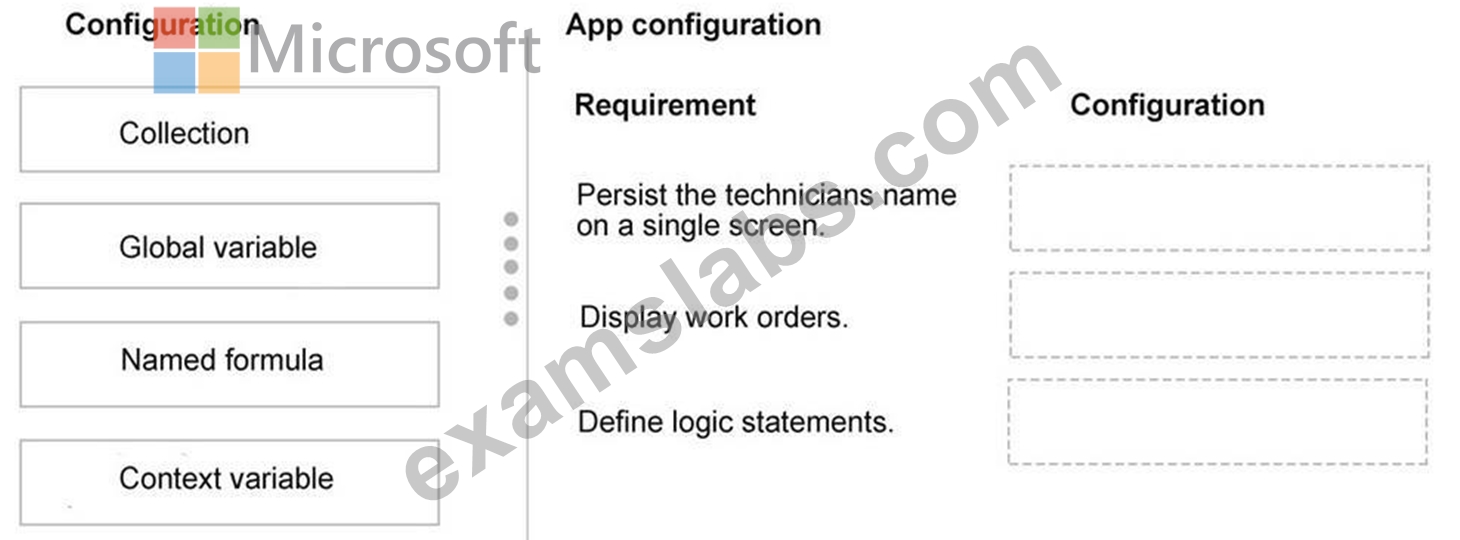
Answer:
Explanation: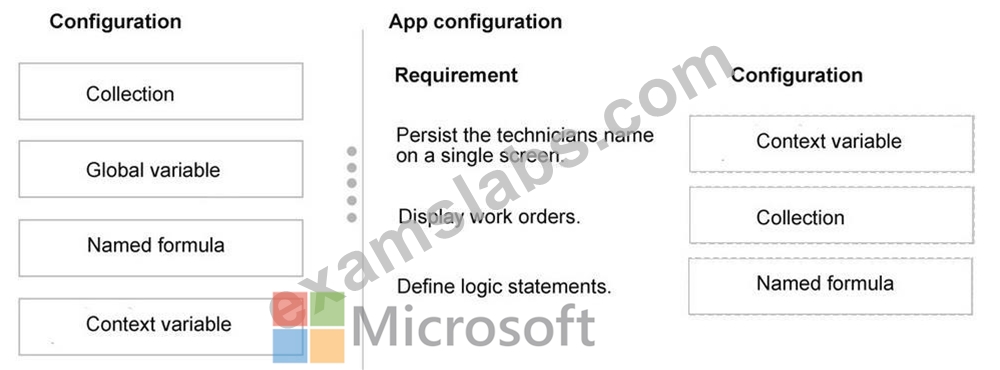
Explanation:
Box 1: Context variable
The new app for the field technicians requires the name of the technician to be persisted on the home screen only.
The correct feature for this requirement is a Context variable.
Screen-Level Scope: Context variables in Power Apps are explicitly designed to hold a temporary state or value that only matters on the current screen.
Isolated Data: Because the requirement explicitly states that the technician's name only needs to be persisted on the home screen only, using a local/context variable ensures the data is isolated and does not occupy unnecessary memory across other pages or screens.
Box 2: Collection
Work orders must be displayed within a gallery.
The correct feature useful for this requirement is a Collection.
Tabular Data Storage: A collection is a specialized local variable in Power Apps explicitly designed to store multi-column data tables, arrays, or groups of records locally.
Gallery Integration: The primary purpose of a Gallery control is to display a list or table of multiple records. Setting the Items property of a gallery directly to a Collection (e.g., ClearCollect(colWorkOrders, WorkOrdersDataSource)) allows you to loop through, manipulate, and cleanly render each work order record.
Box 3: Named formula
Define logic statements.
When writing Power Fx logic inside a model-driven app (such as for Dataverse formula columns or modern commanding), the platform heavily relies on declarative, excel-like calculations.
Named formulas allow developers to define logic statements that automatically recalculate based on their dependencies, without needing manual variable management. They improve app efficiency by calculating values only when they are needed.
Scenario:
The outdated mobile app must be replaced with a new app that supports responsive design principles, provides full control over the UI, and allows technicians to take and upload photos directly from their mobile devices.
The new app for the field technicians requires the name of the technician to be persisted on the home screen only.
In addition, work orders must be displayed within a gallery.
All new apps must connect to a scalable, cloud-based relational data store.
Reference:
https://chrisworth.dev/posts/power-apps-variables-mastery-guide/
NEW QUESTION # 60
An accounting team is assigned to a model-driven app to manage financial data.
The app is currently visible in the app launcher but inaccessible to the accounting team.
Users must be able to:
- Open the app.
- Access and record financial data.
You need to resolve the access issues.
What should you do?
- A. Configure app visibility privileges for the users.
- B. Assign users the appropriate security roles.
- C. Set the app as the default app for the users.
- D. Grant the users table-level permissions to the required tables.
Answer: B
Explanation:
To resolve this issue, you must assign the app's security role to the Team and grant Dataverse table permissions via a security role.
NEW QUESTION # 61
Case Study 2 - Fabrikam Inc
Background
Fabrikam Inc. is an energy provider that operates wind and solar farms across multiple countries and regions. The company uses Microsoft Power Platform to manage asset maintenance, technician workflows, and predictive analytics.
Field technicians use canvas apps on mobile devices to capture inspection and repair data.
Operations managers use model-driven apps to monitor asset performance and maintenance history.
The company plans to enhance its platform by introducing AI-driven insights, improving reuse across applications, and establishing a formal application lifecycle management (ALM) strategy.
Current environment
Applications
Field technicians use an outdated mobile app to log maintenance activities and capture asset readings in SharePoint Online.
Operations managers use a model-driven app to review maintenance records and asset performance trends.
Development practices
Developers build and modify applications directly in the production environment.
There is NO structured ALM process.
Solutions are NOT consistently used to package or deploy application components.
Reusable components are inconsistently implemented across apps, leading to duplication.
AI integration
Fabrikam Inc. plans to actively explore generative AI usage as part of the next phase of work.
Business requirement
Application development
The outdated mobile app must be replaced with a new app that supports responsive design principles, provides full control over the UI, and allows technicians to take and upload photos directly from their mobile devices.
The new app for the field technicians requires the name of the technician to be persisted on the home screen only. In addition, work orders must be displayed within a gallery.
All new apps must connect to a scalable, cloud-based relational data store.
Apps must support efficient data entry for technicians in the field.
Reusable UI elements must be implemented to reduce duplication.
AI capabilities
The company requires a generative AI solution to manage customer complaint responses and create custom inspection reports that align to an existing template.
Customer complaint responses must be generated in applications and based on emails being sent to a mailbox.
Custom AI development must be minimized.
Generative AI reusability
Generative AI solutions must accept dynamic inputs to adapt to different scenarios.
Generative AI solutions must be reusable across different Power Platform services.
Extensibility
Custom UI form components must be reusable across applications.
Use of server-side custom code must be minimized where possible.
Technical requirements
Application lifecycle management (ALM)
Separate environments must be used for development, testing, and production.
Solutions must be used to package application components, segmented based on functional areas.
Managed solutions must be deployed to the production environment.
Validation must occur before deployment to production.
Data processing
Aggregated values across related rows must be displayed for reporting.
Calculations must update automatically as new data is entered. Calculation data must be limited to a maximum length of 10.
Issues
Duplicate logic exists across multiple canvas apps.
Developers frequently overwrite changes in production.
Generative AI solutions produce inconsistent outputs due to missing or inconsistent inputs.
Maintenance metrics are not consistently calculated across related rows.
You need to provide a solution for field technicians to create custom inspection reports natively within the new app. What should you do?
- A. Use a paginated report.
- B. Use a custom prompt.
- C. Create a Word template.
Answer: B
Explanation:
Scenario: The company requires a generative AI solution to manage customer complaint responses and create custom inspection reports that align to an existing template.
You should use a custom prompt.
Generative AI Capability: Power Platform AI Builder prompts leverage large language models (like GPT) to natively handle generative text workflows.
Complaint Handling: A custom prompt can be built specifically to analyze customer feedback and automatically generate draft email or text responses.
Template Alignment: You can embed your exact inspection report layout and instructions directly inside the custom prompt's logic. This ensures that the generated outputs perfectly match the structure of your existing template.
Reference:
https://learn.microsoft.com/en-us/ai-builder/overview
NEW QUESTION # 62
......
AB-410 Practice Test Give You First Time Success with 100% Money Back Guarantee!: https://certificationsdesk.examslabs.com/Microsoft/Microsoft-Certified-Dynamics-365-Sales-AI-Consultant-Associate/best-AB-410-exam-dumps.html