

Best Value Available! 2025 Realistic Verified Free CBAP Exam Questions
Pass Your Exam Easily! CBAP Real Question Answers Updated
NEW QUESTION # 178
You are the business analyst for your organization and are preparing to conduct stakeholder analysis. As part of this process you realize that you'll need several inputs. Which one of the following is NOT an input you'll use for the conduct stakeholder analysis task?
- A. Enterprise architecture
- B. Organizational process assets
- C. Business need
- D. Enterprise environmental factors
Answer: D
Explanation:
Explanation/Reference:
Explanation:
NEW QUESTION # 179
You need to identify assumptions as part of the assessment of capability gaps.
Which of the following is an example of an assumption?
- A. The software must be compatible with the current operating system.
- B. The risk in the project must be quantified.
- C. The project manager believes that her project team members can program in COBOL.
- D. All vendors must have security clearance.
Answer: C
Explanation:
Explanation
An assumption is something that is believed to be true or certain to happen, without proof. Assumptions are often used to fill in the gaps of incomplete or uncertain information, and they can affect the analysis of the current and future states. In this question, the project manager is assuming that her project team members have a certain skill, without verifying it. This is an example of an assumption that should be identified and validated as part of the assessment of capability gaps.
The other options are not assumptions, but rather:
B: A constraint, which is a restriction or limitation that affects the performance or outcomes of a project or solution.
C: A requirement, which is a condition or capability needed by a stakeholder to solve a problem or achieve an objective.
D: A risk, which is an uncertain event or condition that, if it occurs, has a positive or negative effect on one or more project or solution objectives.
References:
CBAP Handbook, page 14, section 4.1.2.2
BABOK Guide, page 30, section 3.2.1
CBAP / CCBA Certified Business Analysis Study Guide, page 94, section 3.2.1
NEW QUESTION # 180
Manufacturer 0 has received a merger proposal from Manufacturer K There is concern among the senior management of Manufacturer O that regulations could shift in the future, prompting Manufacturer K to move headquarters elsewhere and close operations at the current Manufacturer O site. In assessing the proposal limitations and as part of identifying enterprise limitations, a culture assessment is completed. As part of this work, what else would the BA perform?
- A. Financial and risk analysis
- B. Organization and functional modelling
- C. Scope and requirements prioritization
- D. Stakeholder impact and operational analysis
Answer: D
NEW QUESTION # 181
Before the start of a large, cross functional change effort, the team of Business analysts (BAs) assigned decided they need something to help them ensure requirements collectively support one another and do not conflict. What option would provide the consistency they are looking for?
- A. Checklist
- B. Process modeling
- C. Functional decomposition
- D. plate Architecture
Answer: D
Explanation:
Explanation
Plate architecture is a structural system consisting of plates, which are planar, two-dimensional components that only transfer forces in the direction of their level. Plate architecture can help the BAs ensure that the requirements collectively support one another and do not conflict, as it provides a clear and consistent representation of the relationships and dependencies among the requirements. Plate architecture can also help the BAs identify and resolve any gaps, overlaps, or inconsistencies in the requirements, as well as facilitate the communication and verification of the requirements with the stakeholders 12. References:
Plate (structure), Wikipedia
Top Architectural Plates: A Comprehensive Guide 2023, AMTHY
NEW QUESTION # 182
What type of a business analysis approach focuses on the rapid delivery of business value in short iterations?
- A. Change-driven
- B. Profit-driven
- C. Risk-driven
- D. Risk-laden
Answer: A
NEW QUESTION # 183
Bob and Susan are business analysts for their organization. They are examining two materials that could be used in an upcoming project. They are testing the materials and measuring the results of each test to compare the materials to each other. This process will help Bob and Susan determine which material is best for their upcoming project. What type of process are Bob and Susan completing with these materials?
- A. Benchmarking
- B. Feasibility study
- C. Alternative identification
- D. Stress test
Answer: A
NEW QUESTION # 184
What type of a business analysis approach focuses on the rapid delivery of business value in short iterations?
- A. Change-driven
- B. Profit-driven
- C. Risk-driven
- D. Risk-laden
Answer: A
Explanation:
Explanation/Reference:
Explanation:
NEW QUESTION # 185
The ____, an output of the define scope process, does document the process and criteria for accepting completed products.
- A. Project scope statement
- B. Project management plan
- C. Statement of Work
- D. Contract
Answer: A
NEW QUESTION # 186
You are the business analyst for your organization and you are working with Bill on creating a model. Bill is a little confused about all the different things a model can do for the stakeholders.
You explain to Bill that a model can do all of the following except for which one?
- A. Categorize and create hierarchies of items
- B. Show business logic
- C. Define boundaries for business domains
- D. Define the risk and reward for the requirements
Answer: D
Explanation:
Explanation/Reference:
Explanation:
NEW QUESTION # 187
Which of the following roles works with the project team to understand the deliverables and then teaches the users of the deliverables how to utilize the project's product?
- A. End user
- B. Database analyst
- C. Trainer
- D. Stakeholder
Answer: C
Explanation:
Explanation/Reference:
Explanation:
NEW QUESTION # 188
The technology team at a financial institution has successfully constructed a software application to be deployed as part of a digital banking strategy. A business analyst (BA) has completed a review of the current state description and now needs to evaluate the solution and determine limiting factors for value realization.
What additional input is required to perform the assessment of enterprise limitations?
- A. Potential value
- B. Solution performance analysis
- C. Operational assessment
- D. Organizational structure
Answer: C
Explanation:
Explanation
An operational assessment is an input that is required to perform the assessment of enterprise limitations. An operational assessment is a technique that evaluates the current state of the business operations and identifies the gaps, issues, and opportunities for improvement. An operational assessment can help to determine how the solution will affect the existing business processes, policies, procedures, roles, and responsibilities, and how these factors may limit the value realization of the solution. An operational assessment can also help to identify the dependencies, assumptions, constraints, risks, and issues that may arise from the implementation of the solution and how they can be addressed or mitigated.
The other options are not inputs for the assessment of enterprise limitations, but rather outputs or outcomes of the task. Potential value is the expected benefit that the solution will provide to the enterprise and the stakeholders, and it is determined by comparing the current state and the future state of the enterprise. Solution performance analysis is a technique that measures and evaluates the actual performance of the solution against the expected performance and the business objectives. Organizational structure is the arrangement of the roles, responsibilities, and relationships within the enterprise, and it may be affected or changed by the solution.
References:
[BABOK Guide v3], Section 8.4: Assess Enterprise Limitations, p. 206-207 Measure Solution Performance, Task Card: Assess Enterprise Limitations, p. 2 How to assess enterprise limitations - The Functional BA, Blog Post, November 2019
NEW QUESTION # 189
A major manufacturer of popular beverages has appointed a local distributor to serve a specific territory. The demand for the beverages has a pronounced seasonal pattern. The distributor performs well overall, but is repeatedly unable to keep up with fulfilling many customer orders during peak demand periods. The distributor's current delivery capability is stretched to deliver 60 tons of merchandise per day whereas the season's peak demand periods need a daily delivery capability of up to 100 tons.
The distributor is under pressure to fully meet the year-round market demand in order to stay in business. The distributor's management wants to identify and consider more cost-effective options as resorting to adding more trucks and drivers would not be economically feasible. A business analyst (BA) has spent several days observing and measuring the warehouse activities to understand the situation and to gain insights into possible solutions. The delivery workflow is a four- step process: (1) picking the orders and assembling them on trays, (2) bringing the trays to the loading bay, (3) loading the orders into trucks, and (4) delivering the orders to customers. As the following table illustrates, overall performance depends is dependent on five major resources:
(1) the workers who pick the orders and load them into trucks, (2) the tallyers who check the orders, (3) the drivers, (4) the trucks, and (5) eight loading bays (LBs).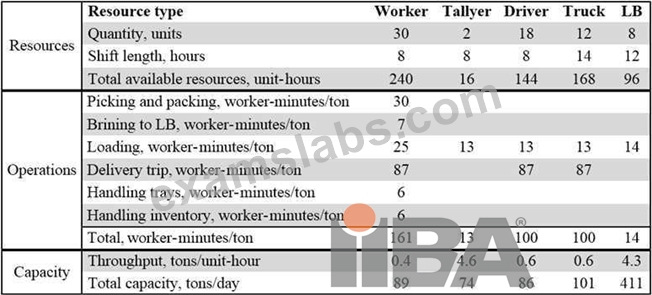
If the driver's average throughput is 0.6 tons/hour, how many hours per day would 15 drivers have to work to deliver 100 tons of merchandise?
- A. 0
- B. 1
- C. 2
- D. 3
Answer: B
NEW QUESTION # 190
A very large insurer of General Liability and Property Damage insurance has an upward trend of increased claims over the past 5 years.
The Risk Control Area for that company has just completed a 12 month Pilot of a new improved Risk Control Site.
The purpose of the site is to help their customers manage their exposures and ideally prevent them from having claims. There were 100 customers that were part of the Pilot that represented 25 different industries.
The business goals were to increase use of the site and provide tools to help customer awareness of their exposures, so that they may reduce existing exposures and ultimately reduce claims.
The sites Features were as follows:
* Improvements to the search engine to all customers to search for articles, tools and services on the site.
* A checklist function that allow customer to create their own unique Checklists or utilize a sample provided by ABC company to use daily, weekly etc for an area of their facility.
* A promotion feature - where Risk preventing Articles, and tools on the site are marketed toward a customer.
* A profile section allowing for Customer Name, Address and contact Phone number.
After the 12 months pilot, the business sponsor received an assessment of what was working and what was not. The Assessment of the pilot revealed overall site activity had significantly increased, however only 5% of the time the promotions were viewed. And the most shocking was that total claims increased by nearly 20% for these 100 customers during the pilot period. The business sponsor was perplexed as he had an expectation of reduced claims and at least for 30% viewing of promotions since the project team had spend a lot of careful time and effort on this feature. A BA was assigned to do further analysis regarding the low use of the promotions and why claims were not being reduced.
Regarding the use of promotion the BA looked into other similar companies to see what they did differently to get their customer to look at their promotions. The BA found that similar companies had promotions that targeted the industry the customer was in so it was more relevant to them and they were more interested to view the promotion. In addition the BA sent out survey to all 100 pilot customers asking probing questions about what they thought of the site and if they felt it had decreased their exposure to risk sufficiently. The Survey responses came back with raving positive comments and providing examples of how the site had been helping in the reduction of claims from the customer's perspective. In addition the survey also revealed insight that the customers found the promotion often irrelevant to their industry.
The BA asked for a dump of all documentation of the 100 claims that were filed over the 12 month pilot period.
The BA found the nearly 90% of the claim field were all in one region of the country and were all for property damage related to several severe winter storms in the region and the claims were nearly all unavoidable by the customers. The BA brought all this analysis back to the business sponsor and made the recommendation to the business sponsor to require the customer to select 1 of 25 industries in their profile. This would in turn allow for the ability to show industry specific promotions and promote search results relative to a customer's industry to be stored at the top giving the customer a more personalized experience.
What technique was the BA using to understand why the promotions were not being viewed?
- A. Benchmarking and market analysis
- B. Observation
- C. Data mining
- D. Use cases and scenarios
Answer: C
NEW QUESTION # 191
Which of the following is a procurement document?
- A. Project Work Breakdown Structure
- B. Project charter
- C. Vision document
- D. Invitation for bid
Answer: D
Explanation:
Explanation
A procurement document is a document that is used to solicit proposals or quotations from potential suppliers or vendors of products or services for a project. A procurement document describes the problem or need, the desired solution, the evaluation criteria, and the contractual terms and conditions. A procurement document can be a request for proposal (RFP), a request for quote (RFQ), a request for information (RFI), or an invitation for bid (IFB). An invitation for bid (IFB) is a type of procurement document that is used to request bids from prospective sellers of products or services. An IFB describes the specifications, quantity, quality, and delivery schedule of the products or services. An IFB invites sellers to submit a sealed bid that indicates the cost of providing the products or services. An IFB is used when the buyer has a well-defined or standard problem or need, and wants to select the lowest bidder among the qualified sellers123. A project work breakdown structure (WBS) is not a procurement document, but a project management document. A WBS is a hierarchical decomposition of the project scope into smaller and manageable components. A WBS defines the deliverables, activities, and tasks that are required to complete the project4. A project charter is not a procurement document, but a project management document. A project charter is a document that formally authorizes the initiation of a project. A project charter defines the purpose, objectives, scope, assumptions, constraints, risks, stakeholders, roles, responsibilities, and authority of the project. A vision document is not a procurement document, but a business analysis document. A vision document is a document that describes the desired future state of a solution. A vision document defines the goals, benefits, features, and scope of the solution. References: CBAP Handbook, CBAP Exam Prep Study Guide, Project Management Institute, Project Work Breakdown Structure, [Project Charter], [Vision Document]
NEW QUESTION # 192
You are creating a model that shows how data moves through a system. Each function that modifies the data in any manner is identified, decomposed to smaller levels, and the system is completely described from start to storage. What type of a modeling technique are you using in this scenario?
- A. Functional decomposition
- B. Data flow diagramming
- C. Organization modeling
- D. Work decomposition
Answer: B
Explanation:
Section: Volume B
Explanation/Reference:
NEW QUESTION # 193
A utility company found mat its current billing system charges customers 'or tie r usage, but does so incorrectly when the system estimates reads on meters rather than performs actual reads. Company stakeholders would i*e to improve this aspect of the system but are hesitant to make changes because they are otherwise pleased with the system A business analyst (BA) has completed a current state diagram and would like to start discussions on what the future state may look like. What information can the BA determine by having a current slate diagram?
- A. The needs for the future state solution
- B. The strengths and weaknesses of the current system
- C. The cost/benefit measures for the new system
- D. The change management plan for implementation
Answer: B
Explanation:
A current state diagram, also known as an as-is process diagram, is a visual representation of the existing processes and workflows of a business or a system. It can help the BA to understand how the current system operates, what are the inputs, outputs, activities, roles, and interactions involved, and what are the pain points, issues, or gaps that need to be addressed. A current state diagram can help the BA to determine the strengths and weaknesses of the current system by highlighting the areas of efficiency, effectiveness, quality, and customer satisfaction, as well as the areas of waste, redundancy, complexity, and inconsistency1234. By identifying the strengths and weaknesses of the current system, the BA can then define the requirements and design the future state solution that will improve the current situation and meet the stakeholder needs12.
References:
* 1: BABOK Guide v3, Chapter 10: Techniques, Section 10.36: Scope Modeling
* 2: BABOK Guide v3, Chapter 10: Techniques, Section 10.37: State Modeling
* 3: What Is Current State Analysis? Benefits and Steps(https://www.indeed.com/career-advice/career- development/current-state-analysis)
* 4: The basics of documenting and analyzing your as-is process(https://www.lucidchart.com/blog/as-is- process-analysis)
NEW QUESTION # 194
A project's change in scope is assessed and a newly assigned business analyst (BA) is unsure how to communicate the findings and final decision to the wider stakeholder group.
In which of the following can the BA find this information?
- A. Governance approach
- B. Business case
- C. Stakeholder Communications Plan
- D. Business policies
Answer: C
Explanation:
Explanation
The Stakeholder Communications Plan is a document that describes how the BA will communicate with the stakeholders throughout the project. It includes information such as the communication objectives, methods, frequency, format, and recipients. The BA can use this plan to determine how to communicate the change in scope and the final decision to the wider stakeholder group. The other options are not relevant to the question.
References:
CBAP / CCBA Certified Business Analysis Study Guide, 2nd Edition, page 77 Business Analysis Body of Knowledge (BABOK) Guide, page 30
NEW QUESTION # 195
The business analysis approach generally defines all of the following attributes except for which one?
- A. Team roles
- B. Analysis technique
- C. Requirements for solutions acceptance
- D. Deliverables
Answer: C
Explanation:
Explanation/Reference:
Explanation:
NEW QUESTION # 196
Which of the following is the process of analyzing the areas of a project that are most affected by risk?
- A. Risk Analysis
- B. Risk Identification
- C. Risk Categorization
- D. Risk Urgency Assessment
Answer: A
Explanation:
Risk analysis is the process of analyzing the areas of a project that are most affected by risk. It involves estimating the probability and impact of each identified risk, as well as assessing the quality and reliability of the available data. Risk analysis helps to prioritize the risks based on their severity and potential effect on the project objectives and deliverables. Risk analysis also helps to identify the root causes and triggers of the risks, as well as the interrelationships and dependencies among the risks. Risk analysis is the second step of risk management, which also includes risk identification, risk response, and risk monitoring and control. References: [IIBA BABOK Guide v3], section 11.2.2, page 387; CBAP / CCBA Certified Business Analysis Study Guide, chapter 5, page 231; CBAP Sample Questions, question 234.
NEW QUESTION # 197
......
Actual Questions Answers Pass With Real CBAP Exam Dumps: https://certificationsdesk.examslabs.com/IIBA/Certified-Business-Analysis-Professional/best-CBAP-exam-dumps.html