

[Jan-2025] The Best CompTIA PenTest+ PT0-003 Professional Exam Questions
Try 100% Updated PT0-003 Exam Questions [2025]
NEW QUESTION # 14
A penetration tester is evaluating a SCADA system. The tester receives local access to a workstation that is running a single application. While navigating through the application, the tester opens a terminal window and gains access to the underlying operating system. Which of the following attacks is the tester performing?
- A. Arbitrary code execution
- B. Process hollowing
- C. Kiosk escape
- D. Library injection
Answer: C
Explanation:
A kiosk escape involves breaking out of a restricted environment, such as a kiosk or a single application interface, to access the underlying operating system. Here's why option A is correct:
Kiosk Escape: This attack targets environments where user access is intentionally limited, such as a kiosk or a dedicated application. The goal is to break out of these restrictions and gain access to the full operating system.
Arbitrary Code Execution: This involves running unauthorized code on the system, but the scenario described is more about escaping a restricted environment.
Process Hollowing: This technique involves injecting code into a legitimate process, making it appear benign while executing malicious activities.
Library Injection: This involves injecting malicious code into a running process by loading a malicious library, which is not the focus in this scenario.
Reference from Pentest:
Forge HTB: Demonstrates techniques to escape restricted environments and gain broader access to the system.
Horizontall HTB: Shows methods to break out of limited access environments, aligning with the concept of kiosk escape.
Conclusion:
Option A, Kiosk escape, accurately describes the type of attack where a tester breaks out of a restricted environment to access the underlying operating system.
NEW QUESTION # 15
A penetration tester completed a vulnerability scan against a web server and identified a single but severe vulnerability.
Which of the following is the BEST way to ensure this is a true positive?
- A. Check the results on the scanner.
- B. Run another scanner to compare.
- C. Look for the vulnerability online.
- D. Perform a manual test on the server.
Answer: D
NEW QUESTION # 16
A penetration tester is conducting a test after hours and notices a critical system was taken down. Which of the following contacts should be notified first?
- A. Emergency
- B. Primary
- C. Secondary
- D. Technical
Answer: B
Explanation:
In the context of penetration testing, the primary contact is typically the first point of contact established before the penetration test begins. This person is usually a stakeholder or an individual who has the authority and responsibility over the system being tested. In the scenario where a critical system is taken down during off-hours, the primary contact should be notified first to ensure a prompt and coordinated response. The primary contact can then decide on the next steps, including escalating the issue to technical, secondary, or emergency contacts if necessary. This approach maintains the chain of command and ensures that the appropriate parties are informed in a structured manner.
NEW QUESTION # 17
A potential reason for communicating with the client point of contact during a penetration test is to provide resolution if a testing component crashes a system or service and leaves them unavailable for both legitimate users and further testing. Which of the following best describes this concept?
- A. Collision detection
- B. De-escalation
- C. Remediation
- D. Retesting
Answer: C
Explanation:
Communicating with the client point of contact during a penetration test, especially when a testing component crashes a system or service, is crucial for remediation. Remediation involves the process of correcting or mitigating vulnerabilities that have been identified during the test. In the context of a system or service becoming unavailable, it's essential to promptly address and resolve the issue to restore availability and ensure the continuity of legitimate business operations. This communication ensures that the client is aware of the incident and can work together with the penetration tester to implement corrective actions, thereby minimizing the impact on the business and further testing activities.
NEW QUESTION # 18
A penetration tester is working on a scoping document with a new client. The methodology the client uses includes the following:
Pre-engagement interaction (scoping and ROE)
Intelligence gathering (reconnaissance)
Threat modeling
Vulnerability analysis
Exploitation and post exploitation
Reporting
Which of the following methodologies does the client use?
- A. OWASP Web Security Testing Guide
- B. NIST SP 800-115
- C. PTES technical guidelines
- D. OSSTMM
Answer: C
Explanation:
Reference: https://kirkpatrickprice.com/blog/stages-of-penetration-testing-according-to-ptes/
NEW QUESTION # 19
A security firm is discussing the results of a penetration test with a client. Based on the findings, the client wants to focus the remaining time on a critical network segment. Which of the following best describes the action taking place?
- A. Eliminating the potential for false positives
- B. Reprioritizing the goals/objectives
- C. Reducing the risk to the client environment
- D. Maximizing the likelihood of finding vulnerabilities
Answer: B
Explanation:
The action of shifting the focus of a penetration test to a specific critical network segment based on the findings during the engagement best aligns with B. Reprioritizing the goals/objectives. because as the client is choosing to change the focus of the testing to a particular area based on the findings. It reflects an adjustment of the original plan or goals to better suit the current understanding of the system's security posture.
NEW QUESTION # 20
A penetration tester has gained access to a network device that has a previously unknown IP range on an interface. Further research determines this is an always-on VPN tunnel to a third-party supplier.
Which of the following is the BEST action for the penetration tester to take?
- A. Scan the IP range for additional systems to exploit.
- B. Stop the assessment and inform the emergency contact.
- C. Disregard the IP range, as it is out of scope.
- D. Utilize the tunnel as a means of pivoting to other internal devices.
Answer: A
NEW QUESTION # 21
During a security audit, a penetration tester wants to run a process to gather information about a target network's domain structure and associated IP addresses. Which of the following tools should the tester use?
- A. Netcat
- B. Dnsenum
- C. Nmap
- D. Wireshark
Answer: B
Explanation:
Dnsenum is a tool specifically designed to gather information about DNS, including domain structure and associated IP addresses. Here's why option A is correct:
Dnsenum: This tool is used for DNS enumeration and can gather information about a domain's DNS records, subdomains, IP addresses, and other related information. It is highly effective for mapping out a target network's domain structure.
Nmap: While a versatile network scanning tool, Nmap is more focused on port scanning and service detection rather than detailed DNS enumeration.
Netcat: This is a network utility for reading and writing data across network connections, not for DNS enumeration.
Wireshark: This is a network protocol analyzer used for capturing and analyzing network traffic but not specifically for gathering DNS information.
Reference from Pentest:
Anubis HTB: Shows the importance of using DNS enumeration tools like Dnsenum to gather detailed information about the target's domain structure.
Forge HTB: Demonstrates the process of using specialized tools to collect DNS and IP information efficiently.
NEW QUESTION # 22
Which of the following assessment methods is MOST likely to cause harm to an ICS environment?
- A. Active scanning
- B. Protocol reversing
- C. Ping sweep
- D. Packet analysis
Answer: A
NEW QUESTION # 23
SIMULATION
You are a penetration tester running port scans on a server.
INSTRUCTIONS
Part 1: Given the output, construct the command that was used to generate this output from the available options.
Part 2: Once the command is appropriately constructed, use the given output to identify the potential attack vectors that should be investigated further.
If at any time you would like to bring back the initial state of the simulation, please click the Reset All button.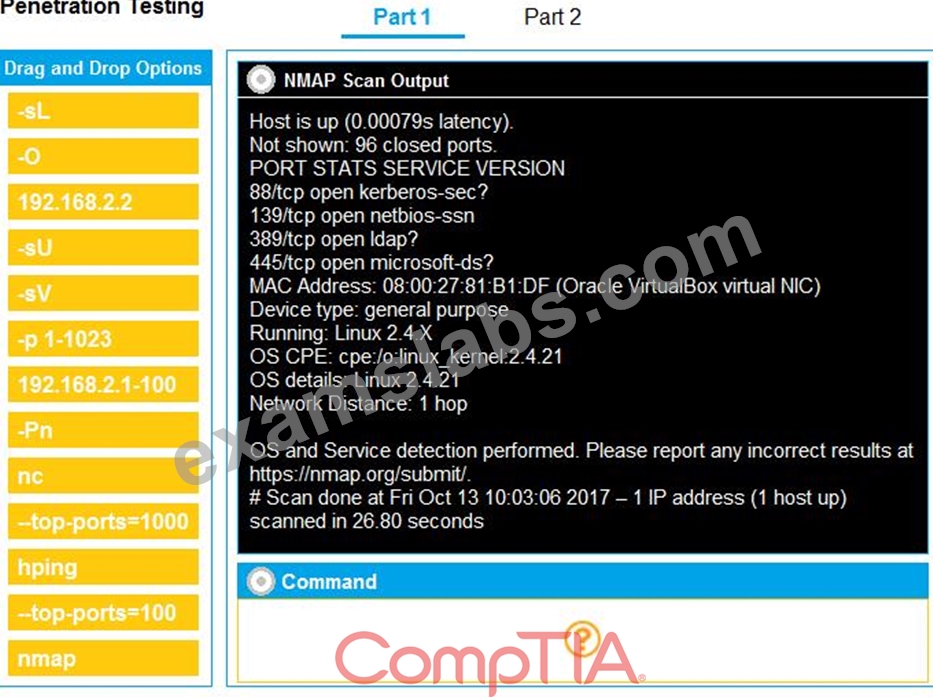
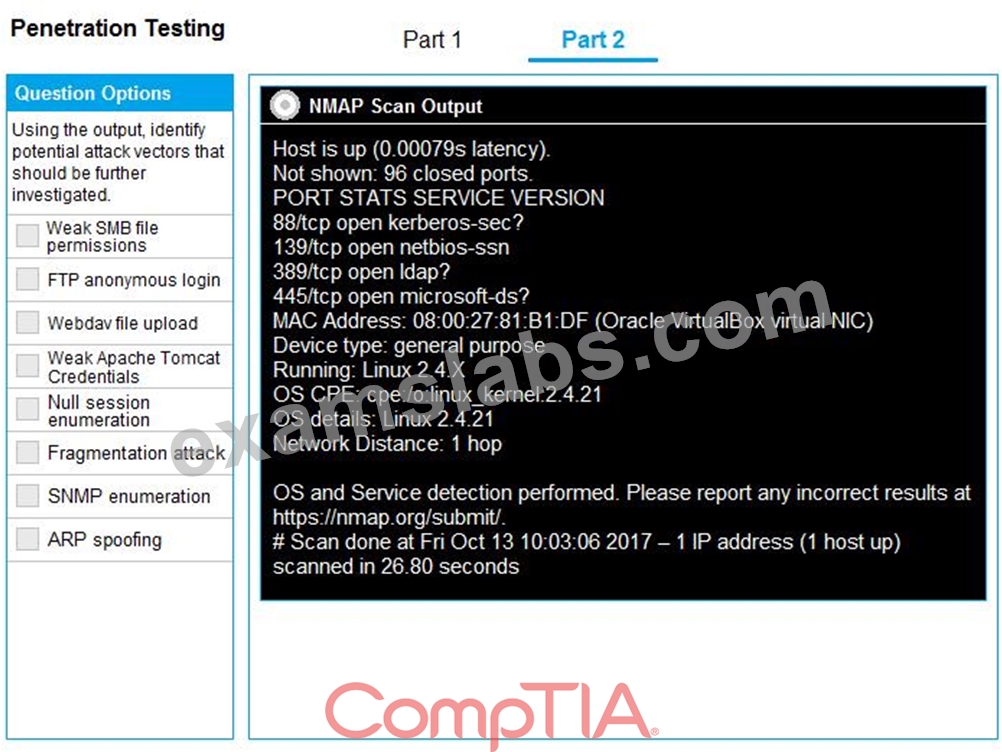
Answer:
Explanation:
See explanation below
Explanation:
Part 1 - 192.168.2.2 -O -sV --top-ports=100 and SMB vulns
Part 2 - Weak SMB file permissions
https://subscription.packtpub.com/book/networking-and-servers/9781786467454/1/ch01lvl1sec13/fingerprinting-os-and-services-running-on-a-target-host
NEW QUESTION # 24
During an engagement, a penetration tester needs to break the key for the Wi-Fi network that uses WPA2 encryption. Which of the following attacks would accomplish this objective?
- A. ChopChop
- B. Replay
- C. Initialization vector
- D. KRACK
Answer: D
Explanation:
KRACK (Key Reinstallation Attack) exploits a vulnerability in the WPA2 protocol to decrypt and inject packets, potentially allowing an attacker to break the encryption key and gain access to the Wi-Fi network.
Step-by-Step Explanation
Understanding KRACK:
Vulnerability: KRACK exploits flaws in the WPA2 handshake process, specifically the four-way handshake.
Mechanism: The attack tricks the victim into reinstalling an already-in-use key by manipulating and replaying handshake messages.
Attack Steps:
Interception: Capture the four-way handshake packets between the client and the access point.
Reinstallation: Force the client to reinstall the encryption key by replaying specific handshake messages.
Decryption: Once the key is reinstalled, it can be used to decrypt packets and potentially inject malicious packets.
Impact:
Decryption: Allows an attacker to decrypt packets, potentially revealing sensitive information.
Injection: Enables the attacker to inject malicious packets into the network.
Mitigation:
Patching: Ensure all devices and access points are patched with the latest firmware that addresses KRACK vulnerabilities.
Encryption: Use additional encryption layers, such as HTTPS, to protect data in transit.
Reference from Pentesting Literature:
The KRACK attack is a significant topic in wireless security and penetration testing guides, illustrating the importance of securing wireless communications.
HTB write-ups and other security assessments frequently reference KRACK when discussing vulnerabilities in WPA2.
Reference:
Penetration Testing - A Hands-on Introduction to Hacking
HTB Official Writeups
NEW QUESTION # 25
A security company has been contracted to perform a scoped insider-threat assessment to try to gain access to the human resources server that houses PII and salary data. The penetration testers have been given an internal network starting position.
Which of the following actions, if performed, would be ethical within the scope of the assessment?
- A. Establishing and maintaining persistence on the domain controller
- B. Leveraging a vulnerability on the internal CA to issue fraudulent client certificates
- C. Gaining access to hosts by injecting malware into the enterprise-wide update server
- D. Exploiting a configuration weakness in the SQL database
- E. Intercepting outbound TLS traffic
Answer: E
NEW QUESTION # 26
A penetration tester was able to gain access successfully to a Windows workstation on a mobile client's laptop. Which of the following can be used to ensure the tester is able to maintain access to the system?
- A. schtasks /create /sc /ONSTART /tr C:\Temp\WindowsUpdate.exe
- B. wmic startup get caption,command
- C. sudo useradd -ou 0 -g 0 user
- D. crontab -l; echo "@reboot sleep 200 && ncat -lvp 4242 -e /bin/bash") | crontab 2>/dev/null
Answer: A
NEW QUESTION # 27
A company conducted a simulated phishing attack by sending its employees emails that included a link to a site that mimicked the corporate SSO portal. Eighty percent of the employees who received the email clicked the link and provided their corporate credentials on the fake site. Which of the following recommendations would BEST address this situation?
- A. Restrict employees from web navigation by defining a list of unapproved sites in the corporate proxy.
- B. Implement an email security gateway to block spam and malware from email communications.
- C. Implement a recurring cybersecurity awareness education program for all users.
- D. Implement multifactor authentication on all corporate applications.
Answer: C
Explanation:
The simulated phishing attack showed that most of the employees were not able to recognize or avoid a common social engineering technique that could compromise their corporate credentials and expose sensitive data or systems. The best way to address this situation is to implement a recurring cybersecurity awareness education program for all users that covers topics such as phishing, password security, data protection, and incident reporting. This will help raise the level of security awareness and reduce the risk of falling victim to phishing attacks in the future. The other options are not as effective or feasible as educating users about phishing prevention techniques.
Reference: https://resources.infosecinstitute.com/topic/top-9-free-phishing-simulators/
NEW QUESTION # 28
Which of the following provides a matrix of common tactics and techniques used by attackers along with recommended mitigations?
- A. NIST SP 800-53
- B. PTES technical guidelines
- C. MITRE ATT&CK framework
- D. OWASP Top 10
Answer: C
Explanation:
Reference: https://digitalguardian.com/blog/what-mitre-attck-framework
NEW QUESTION # 29
A penetration tester conducted an assessment on a web server. The logs from this session show the following:
http://www.thecompanydomain.com/servicestatus.php?serviceID=892&serviceID=892 ' ; DROP TABLE SERVICES; -- Which of the following attacks is being attempted?
- A. Cross-site scripting
- B. Session hijacking
- C. Clickjacking
- D. Cookie hijacking
- E. Parameter pollution
Answer: E
NEW QUESTION # 30
Which of the following documents describes specific activities, deliverables, and schedules for a penetration tester?
- A. MSA
- B. MOU
- C. NDA
- D. SOW
Answer: D
Explanation:
As mentioned in question 1, the SOW describes the specific activities, deliverables, and schedules for a penetration tester. The other documents are not relevant for this purpose. An NDA is a non-disclosure agreement that protects the confidentiality of the client's information. An MSA is a master service agreement that defines the general terms and conditions of a business relationship. An MOU is a memorandum of understanding that expresses a common intention or agreement between parties.
NEW QUESTION # 31
During a penetration test, a tester attempts to pivot from one Windows 10 system to another Windows system. The penetration tester thinks a local firewall is blocking connections. Which of the following command-line utilities built into Windows is most likely to disable the firewall?
- A. bitsadmin.exe
- B. msconfig.exe
- C. netsh.exe
- D. certutil.exe
Answer: C
Explanation:
Understanding netsh.exe:
Purpose: Configures network settings, including IP addresses, DNS, and firewall settings.
Firewall Management: Can enable, disable, or modify firewall rules.
Disabling the Firewall:
Command: Use netsh.exe to disable the firewall.
netsh advfirewall set allprofiles state off
Usage in Penetration Testing:
Pivoting: Disabling the firewall can help the penetration tester pivot from one system to another by removing network restrictions.
Command Execution: Ensure the command is executed with appropriate privileges.
Reference from Pentesting Literature:
netsh.exe is commonly mentioned in penetration testing guides for configuring network settings and managing firewalls.
HTB write-ups often reference the use of netsh.exe for managing firewall settings during network-based penetration tests.
Reference:
Penetration Testing - A Hands-on Introduction to Hacking
HTB Official Writeups
NEW QUESTION # 32
Which of the following tools provides Python classes for interacting with network protocols?
- A. Empire
- B. PowerSploit
- C. Impacket
- D. Responder
Answer: C
Explanation:
Impacket is a collection of Python classes focused on providing access to network protocols. It is designed for low-level protocol access and crafted to perform various networking tasks from Python scripts. This toolkit is widely used in penetration testing for creating and decoding network protocols and for crafting and injecting packets into the network. Impacket supports a myriad of protocols like IP, TCP, UDP, ICMP, SMB, MSRPC, NTP, and more. With its vast array of functionalities, Impacket is very useful in protocol testing and attacks, like the ones a penetration tester would conduct.
Responder, on the other hand, is a LLMNR, NBT-NS, and MDNS poisoner that can be used for capturing NetNTLM hashes. Empire is a post-exploitation framework that allows the use of PowerShell for offensive security and PowerSploit is a collection of Microsoft PowerShell modules that can be used to aid penetration testers during all phases of an assessment.
Given these descriptions, Impacket is the tool that fits the context of the question due to its direct interaction with network protocols through Python.
NEW QUESTION # 33
A penetration testing firm wants to hire three additional consultants to support a newly signed long-term contract with a major customer. The following is a summary of candidate background checks: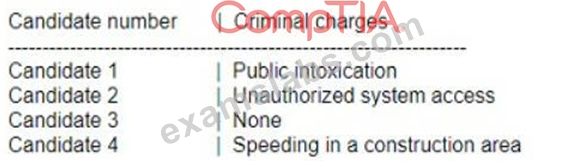
Which of the following candidates should most likely be excluded from consideration?
- A. Candidate 1
- B. Candidate 2
- C. Candidate 3
- D. Candidate 4
Answer: B
Explanation:
In the context of penetration testing or cybersecurity, hiring a consultant with a background in unauthorized system access could present both risks and benefits. From a risk management perspective, Candidate 2's history of unauthorized system access is a significant red flag. Such past behavior indicates a willingness to operate outside of legal and ethical boundaries, which could pose a risk to the firm and its clients, especially in a role that requires trust and adherence to legal guidelines.
However, the very skills that enabled unauthorized access might also provide the firm with deep insights into hacker methodologies, potentially enhancing the firm's capability to secure systems against such intrusions. It is a common practice in the cybersecurity industry to employ individuals with a history of hacking in roles where they can contribute positively, known as "ethical hacking" or "white hat" roles.
Nonetheless, given the legal and ethical responsibilities inherent in cybersecurity work, Candidate 2's past criminal charge of unauthorized system access is the most pertinent to the role and poses the most direct risk to the firm's operations and reputation. It would be crucial for the firm to conduct a thorough risk assessment, including the nature of the unauthorized access, the candidate's subsequent actions, rehabilitation, and current capabilities, before making a hiring decision.
From the provided information, it appears that Candidate 2 should most likely be excluded from consideration due to the direct relevance of their criminal charges to the position in question. Without evidence of rehabilitation and a clear demonstration of ethical standards, the liability risks might outweigh the potential benefits to the firm.
NEW QUESTION # 34
Which of the following is the MOST important information to have on a penetration testing report that is written for the developers?
- A. Methodology
- B. Metrics and measures
- C. Remediation
- D. Executive summary
Answer: C
Explanation:
The most important information to have on a penetration testing report that is written for the developers is remediation. Remediation is the process of fixing or mitigating the vulnerabilities or issues that were discovered during the penetration testing. Remediation should include specific recommendations, best practices, and resources to help the developers improve the security of their applications4.
NEW QUESTION # 35
......
PT0-003 Exam Questions Get Updated [2025] with Correct Answers: https://certificationsdesk.examslabs.com/CompTIA/CompTIA-PenTest/best-PT0-003-exam-dumps.html